














The VA rating code sheet is an essential internal document summarizing the Department of Veterans Affairs’ decisions on your disability claims. It details your service-connected conditions, assigned diagnostic codes, effective dates, and the percentage rating for each. This sheet is crucial because it provides the detailed logic behind your disability benefits, including how combined ratings are calculated and whether conditions are static or subject to future review.
While not automatically sent with your award letter, obtaining and understanding this document is vital for reviewing decisions, identifying potential errors, and preparing for any appeals. It acts as a comprehensive blueprint of your VA disability compensation, empowering you to ensure accuracy and advocate for the benefits you deserve.
Why This Update
The VA rating code sheet is an important tool in understanding your benefits. We want to review our information and make sure it is up to date!
What is a VA Rating Code Sheet?
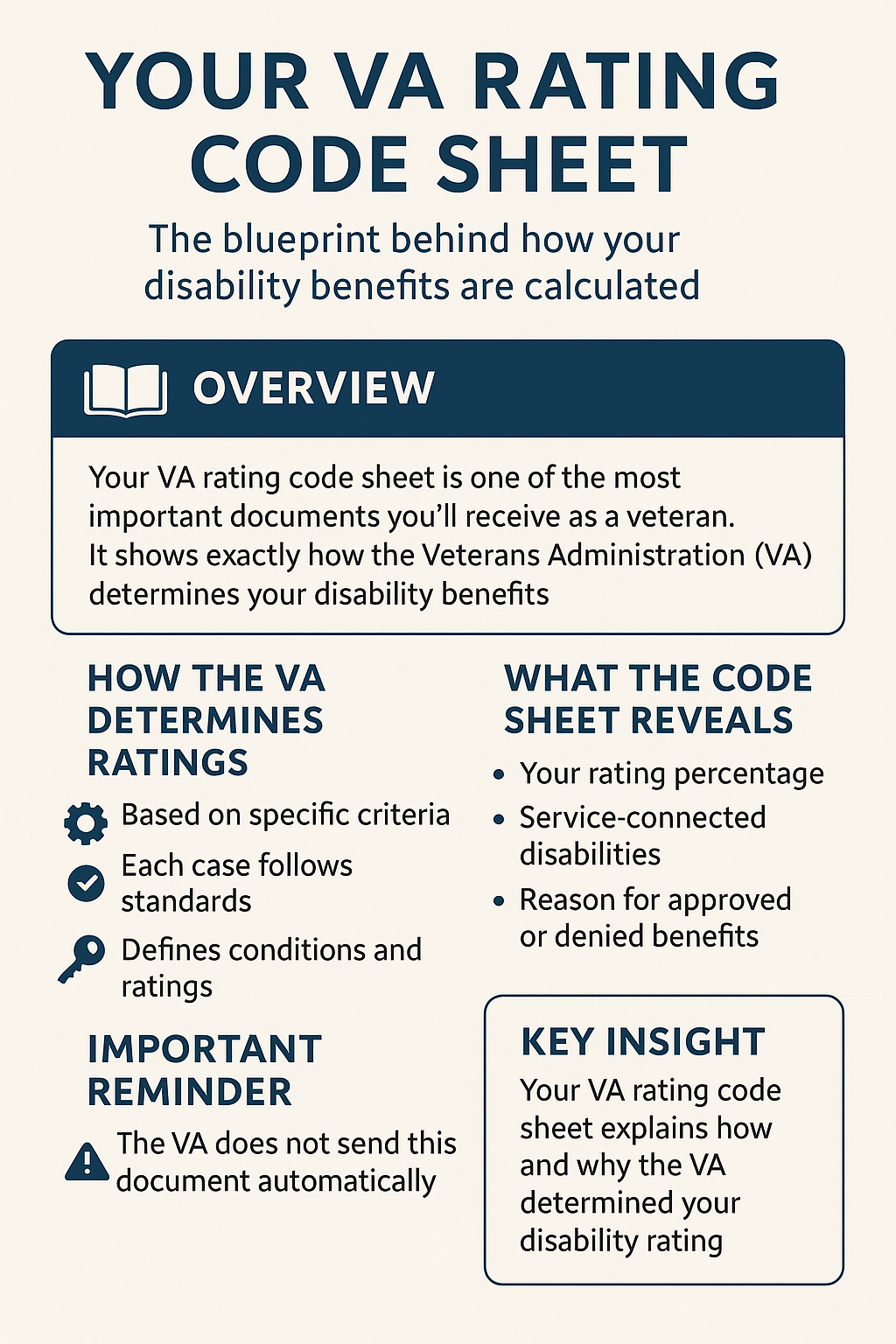
The VA rating code sheet is an internal document that summarizes all the decisions the Department of Veterans Affairs has made about your claims. It’s like a detailed blueprint of your benefits. This document lists every service-connected condition you have, along with the diagnostic codes assigned to each, the effective dates when your ratings began, and the specific percentage rating the VA determined for each condition.
The code sheet also includes important status indicators for each condition. These indicators show whether the VA considers a condition static (not likely to improve), or whether it might be subject to future medical examinations and potential re-evaluation. While the VA generates a rating code sheet with every finalized rating decision, the VA doesn’t automatically send it with your award letter. You need to request it separately to get this comprehensive view of how your benefits were calculated, as part of understanding your overall veterans disability benefits.
Why Your VA Rating Code Sheet Matters
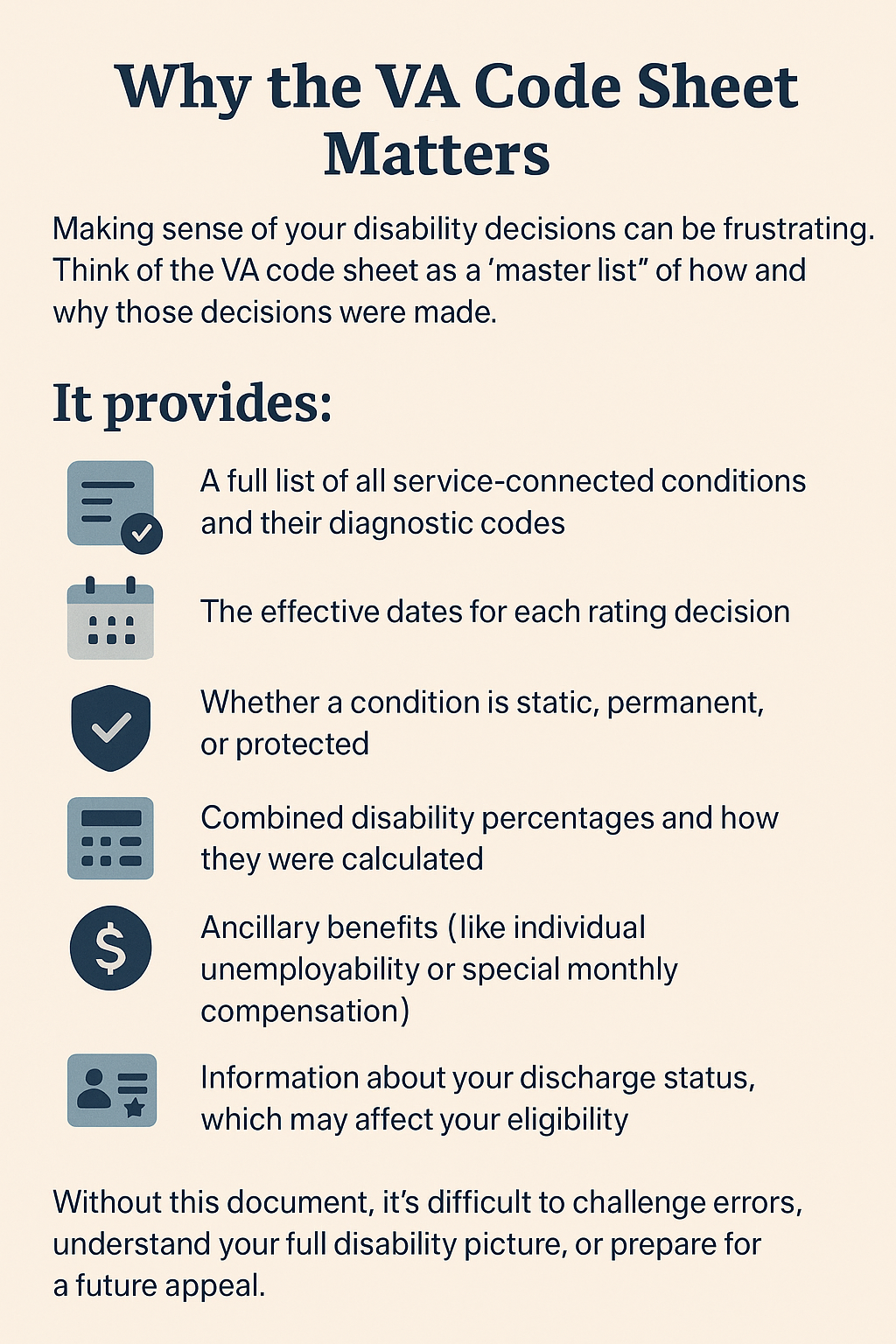
Your rating code sheet serves as the main reference document that explains how the VA arrived at your disability rating and compensation amount, including details on VA disability compensation rates. It provides the foundation for understanding your entire situation, showing not just what conditions are service-connected, but when those ratings took effect and what their current status is.
This timing matters significantly because effective dates determine how much retroactive pay you may be entitled to receive. The code sheet also reveals how the VA calculated your combined rating percentage, which uses a specific mathematical formula rather than simply adding up individual ratings.
This detailed breakdown is important when you’re trying to verify that the VA correctly applied their own rating rules. If you’re considering an appeal, preparing to file for an increase, or simply want to understand why your rating came out the way it did, this document provides the answers. It helps you spot potential errors, identify conditions that might have been overlooked, and make informed decisions about your benefits.
Decoding Your VA Rating Code Sheet
When you receive your rating code sheet, you’ll find it organized into several key sections. The document typically starts with a list of all your service-connected conditions, each paired with its corresponding diagnostic code and the individual percentage rating assigned.
These diagnostic codes are numbers that link your specific medical conditions to the criteria outlined in the VA’s Schedule for Rating Disabilities. Your code sheet also displays the effective date for each rating, which is important information that directly impacts your retroactive compensation.
You’ll see decision codes and annotations that indicate whether the VA considers each condition permanent, static, or subject to future re-examination. Understanding these designations helps you know which ratings are more secure and which might face review.
The document explains the VA’s combined rating calculation, showing how multiple percentages are merged using the VA’s unique formula. This section often surprises veterans because the math doesn’t work the way you might expect. Additionally, your code sheet may include notes about special considerations such as the bilateral factor (when you have conditions affecting both sides of your body), Individual Unemployability status, or eligibility for Special Monthly Compensation for particularly severe conditions.
Current VA regional office contact information can be found using the VA’s facility locator, and Privacy Act request procedures are detailed on the VA Freedom of Information Act (FOIA) website. These resources help you locate your nearest regional office and understand the proper process for requesting your rating code sheet.
Key Terms and Codes Explained
Understanding the abbreviations and terminology on your rating code sheet is important for making sense of your benefits and staying informed about important updates for veteran families. “SC” stands for Service Connected, confirming that the VA has established a link between a particular condition and your military service. “NSC” means Not Service Connected, indicating the VA determined a condition is not related to your service.
The term “static” describes a condition the VA believes will not improve, meaning it generally won’t require future re-evaluations. “Permanent” indicates the VA expects your rating to remain unchanged going forward, typically due to the nature of the condition or your age.
You may also see references to protected ratings on your code sheet. The rules around rating protection are complex and depend on how long a rating has been in effect. Specific protection rules for VA ratings after 10 and 20 years are outlined in 38 CFR 3.105(e) and 38 CFR 3.957, respectively. These regulations govern when and how the VA can reduce established ratings.
Common Issues and Discrepancies on Code Sheets
Even though the VA works to process claims accurately, errors do occur on rating code sheets. One of the most common problems involves conditions being rated at lower percentages than the evidence supports, or effective dates being set incorrectly, which may cost you significant amounts in retroactive pay. Sometimes the VA’s calculation of your combined rating percentage contains mathematical errors.
Other discrepancies include the VA failing to list all your eligible service-connected conditions, or incorrectly classifying conditions as non-service connected when evidence supports a service connection. You might also find missing or outdated diagnostic codes that don’t reflect current medical understanding or updated VA rating policies.
Each of these errors may directly reduce your monthly compensation or affect your eligibility for additional benefits like healthcare or dependent allowances. Because these mistakes may have significant financial impact, reviewing each line of your rating code sheet carefully is important. Catching and correcting errors early may affect the difference between receiving the full benefits you’ve earned and settling for less.
How to Request Your VA Rating Code Sheet
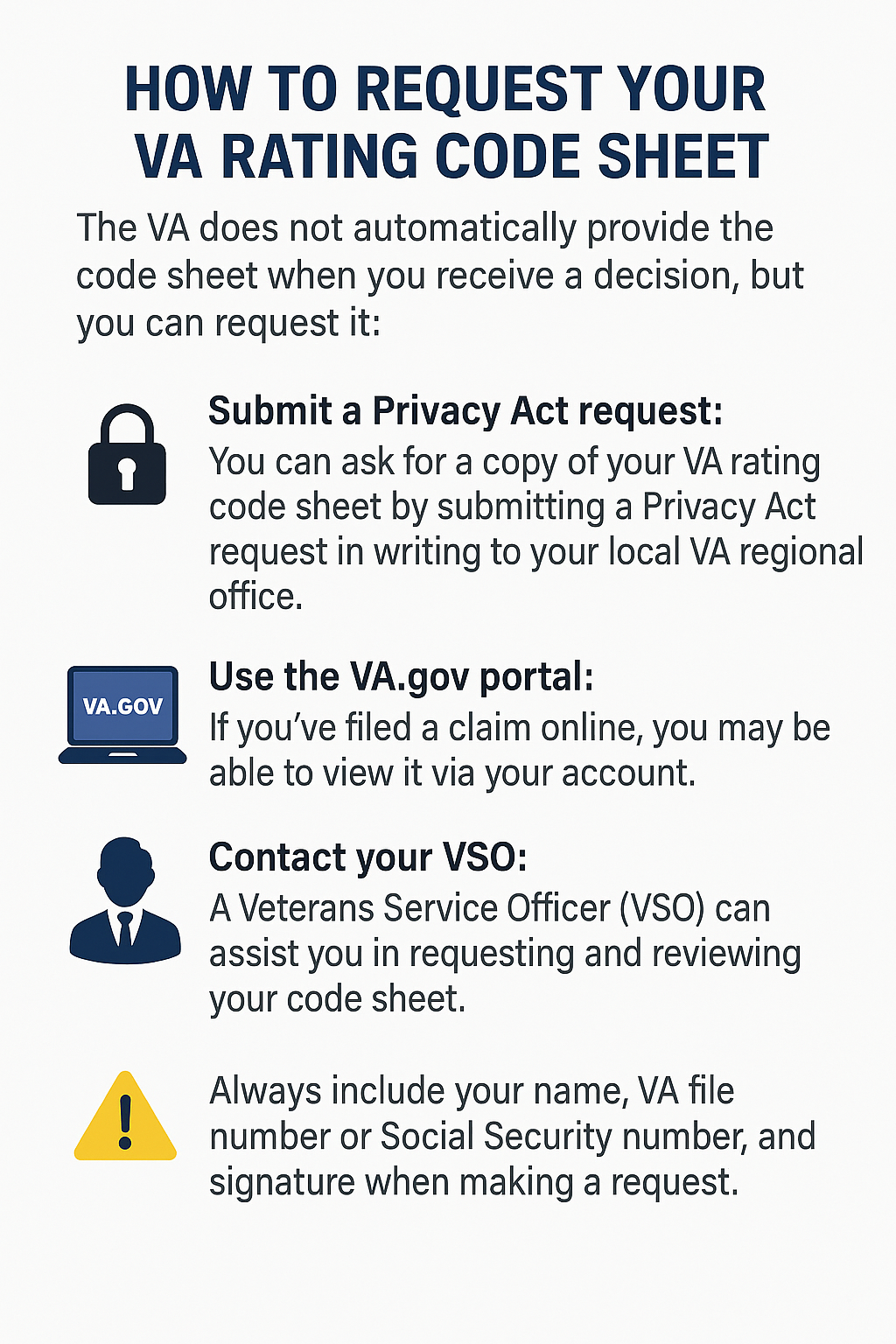
The VA doesn’t automatically send you a rating code sheet with your decision letter, so you’ll need to request it. You can submit a Privacy Act request in writing to your local VA regional office. Current VA regional office contact information can be found using the VA’s facility locator, and Privacy Act request procedures are detailed on the VA Freedom of Information Act (FOIA) website.
Some veterans also find their code sheet accessible through their online VA.gov account, though this varies by region and claim type. If the request process feels confusing, Veterans Service Officers (VSOs) can provide valuable assistance. There are also many helpful mobile apps for veterans that can offer support. VSOs are experienced in requesting and interpreting rating code sheets, and they can help you understand what you’re looking at once you receive it.
Example Scenario
If you’ve received a VA decision that seems incorrect or unclear, requesting your rating code sheet can be an important step. One veteran, after reviewing their code sheet, discovered that an effective date for a service-connected condition was listed incorrectly, impacting their retroactive pay. By using the detailed information from the sheet, you can pinpoint specific errors and gather the evidence needed to challenge the decision, which may lead to a more accurate rating and compensation.
Frequently Asked Questions
What is a VA rating code sheet?
It’s an internal VA document detailing your service-connected conditions, ratings, diagnostic codes, and the VA’s reasoning behind your disability decisions.
How do I get my VA rating code sheet?
You must specifically request it from the VA, either through a Privacy Act request to a regional office or with the assistance of a Veterans Service Officer (VSO).
Why isn’t the code sheet automatically sent with my award letter?
The VA considers it an internal administrative document, not typically included by default with the summary award letter.
Can I use my VA rating code sheet for an appeal?
Yes, it is a vital tool for appeals, as it provides a detailed record that can help identify mistakes, overlooked conditions, or incorrect effective dates.
Is the VA rating code sheet the same as my award letter?
No, the award letter is a summary of the decision, while the code sheet provides the intricate, detailed breakdown and calculations behind that decision.
What kind of errors should I look for on my code sheet?
Look for incorrect service-connection statuses, inaccurate effective dates, miscalculated combined ratings, missing conditions, or outdated diagnostic codes that may affect your benefit amount.
How do diagnostic codes impact my disability rating?
Diagnostic codes link your specific medical conditions to the VA’s Schedule for Rating Disabilities, which outlines the criteria and severity levels used to assign a percentage rating and determine your compensation.
Don’t wait until you’re facing a denial or a confusing decision. At Benefits.com, we are here to help you navigate the process and receive the benefits you deserve. Begin today by taking our free eligibility quiz.
 Benefits.com Advisors
With expertise spanning local, state, and federal benefit programs, our team is dedicated to guiding individuals towards the perfect program tailored to their unique circumstances.
Rise to the top with Peak Benefits!
Join our Peak Benefits Newsletter for the latest news, resources, and offers on all things government benefits.