













Basic Allowance for Housing (BAH) is a crucial supplement provided to U.S. uniformed service members who do not live in government housing. This allowance helps offset the cost of civilian rental housing, with rates determined by local market conditions including median rents and average utility costs within specific Military Housing Areas (MHAs).
BAH rates are influenced by the service member’s rank, pay grade, duty station, and dependency status, and are adjusted annually to reflect current housing market fluctuations. Designed to support military personnel facing limited flexibility in their living situations and income, BAH is vital for securing suitable housing. While it doesn’t cover all living expenses, it significantly contributes to housing affordability for service members.
Why This Update
BAH rates are reviewed annually, we want to make sure our information is up to date!
What is Basic Allowance for Housing (BAH)?
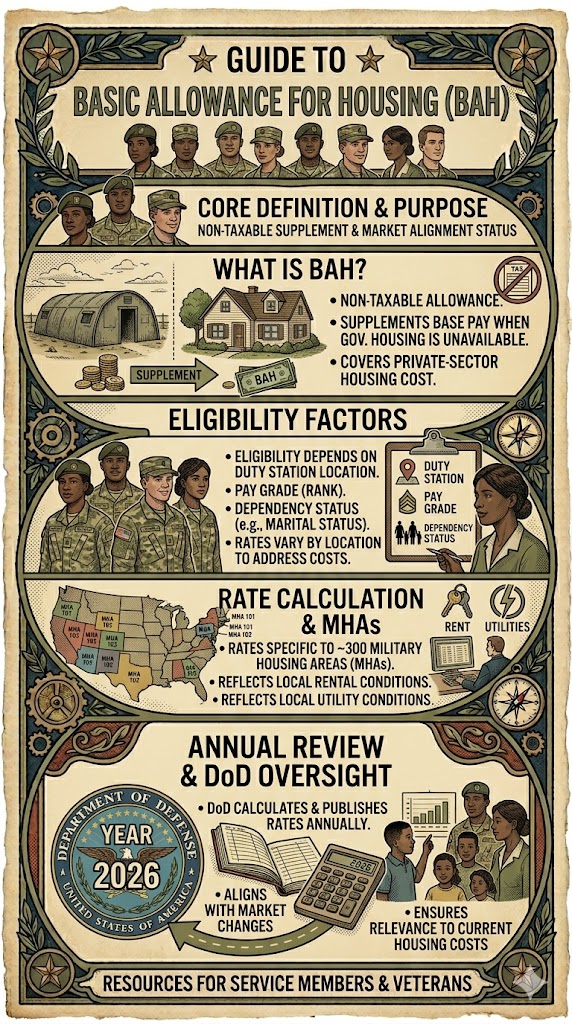
BAH is a non-taxable allowance supplementing a service member’s base pay when government housing is unavailable. It helps cover the cost of private-sector housing, reflecting local rental and utility market conditions. This benefit varies by location to address the specific housing costs in each area.
Rates are specific to approximately 300 Military Housing Areas (MHAs) across the States. Eligibility depends on the service member’s duty station, pay grade, and dependency status. The Department of Defense (DoD) calculates and publishes BAH rates annually to align with market changes, helping ensure the allowance remains relevant to current housing costs in each location.
How BAH Rates Are Calculated and Determined
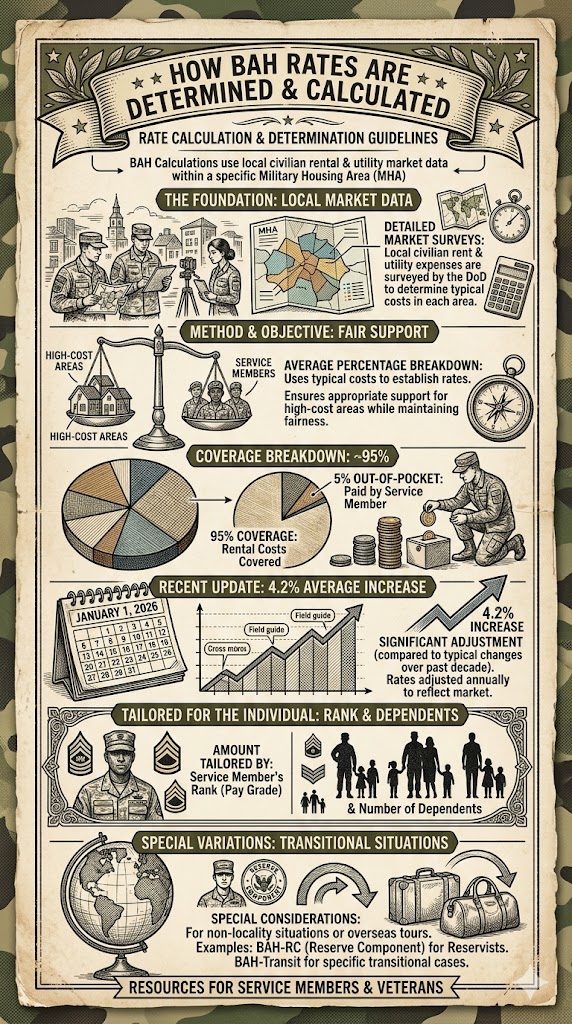
BAH calculations are based on average monthly rent in local civilian housing markets, along with average utility expenses in a specific MHA. The Department of Defense conducts detailed market surveys to determine typical housing costs in each area, using an average percentage breakdown of rent and utilities to establish housing rates.
This approach helps ensure that service members stationed in high-cost areas receive appropriate support while maintaining fairness across all locations. BAH is designed to cover approximately 95% of rental costs, with the remaining 5% typically paid out-of-pocket by the service member.
BAH rates increased by an average of 4.2% January 1, 2026, marking a significant adjustment compared to typical changes over the past decade.
Individual allowance amounts are tailored by the service member’s rank (pay grade) and number of dependents. Rates are adjusted annually, with new rates typically released at the start of the calendar year to reflect current market conditions.
Special considerations exist for non-locality situations or overseas tours, which may result in different allowances. These variations include BAH-RC (Reserve Component) for Reservists and BAH-Transit for service members in specific transitional situations.
BAH Rate Protection and Special Circumstances
Service members receive rate protection, which ensures that if an area’s housing costs decrease, they continue to receive their prior BAH rate as long as their member’s duty location, pay grade, and dependency status remain unchanged. The prior BAH rate exists as a benchmark for this protection, preventing a sudden reduction in housing allowance due to local market rate decreases.
Dual military BAH applies when both spouses are active duty service members. In these cases, BAH is calculated based on each member’s rank, dependency status, and whether they have a dependent child. If both are eligible, only one may claim the with-dependents rate, typically the higher-ranking member or the one with primary custody of a dependent child.
Navigating BAH for Your Financial Planning

BAH is intended to offset rental costs and utilities, but not homeownership costs such as mortgage payments or property taxes. The allowance is designed to cover approximately 95 percent of rental housing costs in a given area, so service members should plan carefully to ensure all expenses fit within their budget.
Service members have flexibility in their housing choices, allowing them to rent expensive housing close to their duty station or opt for more affordable options farther away, depending on their needs and preferences.
If they find housing where the rent is below the BAH amount, they may keep all their housing allowance, enabling them to make informed decisions and potentially save money or allocate funds toward other financial goals. This flexibility in housing choices is especially valuable given the limited flexibility in military careers, making strategic use of BAH important for overall financial stability.
Example Scenario
If a service member is stationed at a new duty post, the housing allowance amount they receive is determined by the duty station location, their rank, and dependency status. If they initially find an apartment that costs less than their allocated BAH, they will continue to receive the full allowance.
This flexibility allows the service member stationed there to save the difference or allocate it towards other household expenses. However, if they later decide to move to a larger home as their family grows, they can use their BAH—calculated based on the housing allowance amount for their duty station location—to help cover the increased rent without the allowance decreasing.
Frequently Asked Questions
How often are BAH rates updated?
BAH rates are updated annually, typically at the beginning of each calendar year, to reflect changes in local housing markets across the United States. For BAH RC/T, the rates are set by increasing the previous year’s rates based on the national average percentage growth of housing costs, while BAH-Diff is adjusted by the percentage growth of military basic pay.
Can my BAH go down if housing costs decrease in my area?
Generally, no. Service members are protected from a decrease in BAH due to market fluctuations unless there is a change in their duty station, pay grade, or dependency status.
Does BAH cover all my housing expenses, like utilities?
BAH is calculated using average utility costs, but it’s not intended to cover all housing expenses entirely. It’s a supplement, and service members are encouraged to budget carefully for all costs.
What factors determine my specific BAH amount?
Your BAH amount is determined by your duty station’s Military Housing Area, your rank (pay grade), and whether you have dependents.
What is BAH-Differential?
BAH-Differential (BAH-Diff) applies to service members in single-type quarters who pay child support. It’s a reduced allowance designed for specific situations.
Where can I find the official BAH rates for my location?
Official BAH rates are published annually by the Department of Defense and can typically be found on official military pay websites or through your local finance office.
Can I receive BAH if I’m living on base?
No, eligible BAH is specifically provided to military members who are active duty service members and do not have access to government-provided housing; it is intended for those who must secure housing in the civilian market.
 Benefits.com Advisors
With expertise spanning local, state, and federal benefit programs, our team is dedicated to guiding individuals towards the perfect program tailored to their unique circumstances.
Rise to the top with Peak Benefits!
Join our Peak Benefits Newsletter for the latest news, resources, and offers on all things government benefits.