













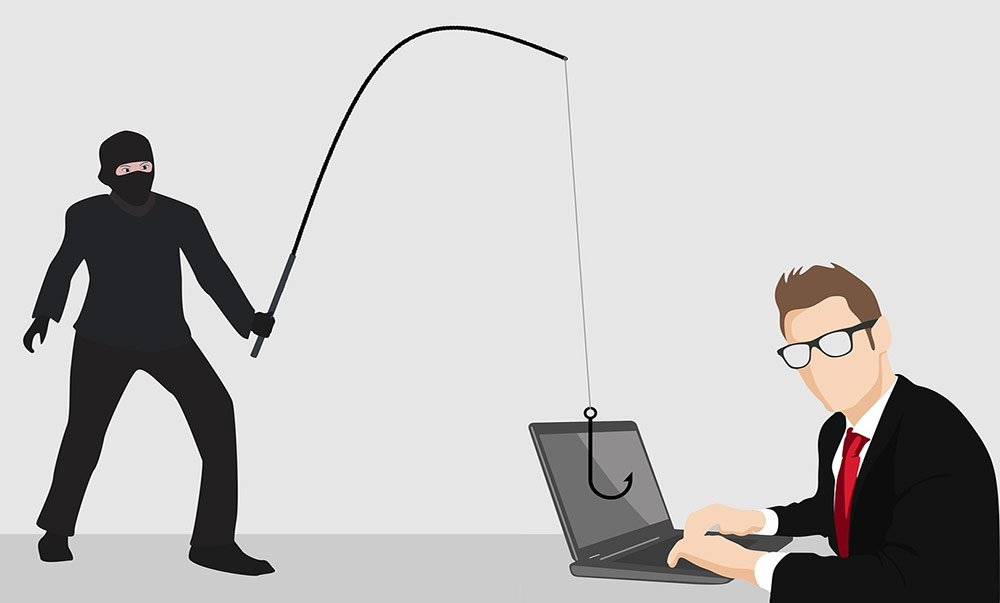
Pension poaching is when unethical financial planners or fake legal advisors target elderly and disabled veterans eligible for VA pensions. The U.S. Department of Veterans Affairs and the Pennsylvania Department of Military and Veterans Affairs provide legitimate assistance and information to veterans seeking benefits.
Scammers charge illegal upfront fees—sometimes up to $6,000—to restructure veterans’ finances through irrevocable trusts or expensive annuities, falsely claiming this helps them qualify for benefits. Veterans should consult trusted sources, such as official VA departments, before making any financial changes suggested by advisors, especially regarding asset relocation.
Scammers often lie about or ignore official VA pension eligibility requirements. Under federal law, no one can charge fees for preparing initial VA benefit applications, and free help must be available through VA-accredited representatives.
What Is Veteran Pension Poaching?
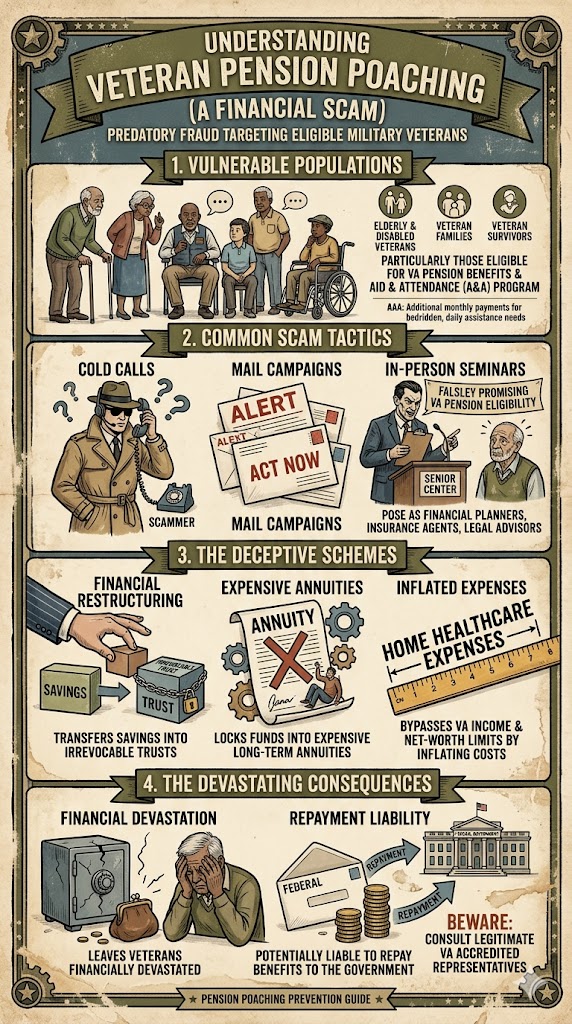
Veteran pension poaching is a predatory financial scam targeting military veterans, their survivors, and families—particularly elderly and disabled veterans eligible for VA pension benefits or the Aid and Attendance (A&A) program. The A&A program provides additional monthly payments to veterans who are bedridden or require daily assistance with basic activities.
Scammers typically reach victims through cold calls, mail campaigns, and in-person seminars at senior centers or assisted living facilities. They pose as financial planners, insurance agents, or legal advisors, falsely promising to help veterans qualify for income-based VA pensions by restructuring their finances.
Their tactics include transferring retirement savings into irrevocable trusts, locking funds into expensive long-term annuities, or inflating home healthcare expenses to bypass VA income and net-worth limits. These schemes leave veterans financially devastated and potentially liable to repay benefits to the federal government.
The Scale of the Problem
Veterans face disproportionate targeting by financial fraudsters due to the consistency of their government compensation. According to AARP, service members and veterans are significantly more likely to be targeted by fraudulent solicitations than civilians—35% versus 25%.
Nearly half of former and active-duty service members approached by pension poachers have mistakenly signed over their VA benefits, according to a report by AARP. Additionally, over half of veterans in Pennsylvania are aged 60 and older, making older veterans particularly vulnerable to pension poaching scams.
How the Scams Work and Legal Consequences
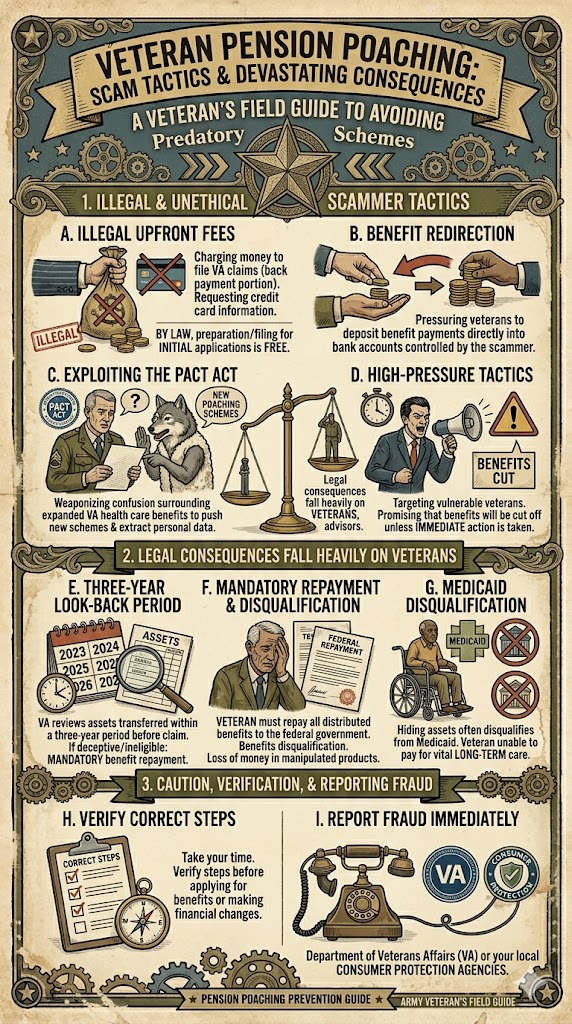
Scammers employ several illegal or highly unethical tactics to exploit veterans:
- Illegal Upfront Fees: Scammers may try to charge money, sometimes as a portion of the eventual back payment or benefits, to file VA claims. They may also request credit card information under the guise of assisting with claims. By law, no one can charge for preparing or filing an initial VA benefits application.
- Benefit Redirection: Pressuring veterans to deposit VA benefit payments directly into bank accounts controlled by the scammer rather than the rightful beneficiary.
- Exploiting the PACT Act: Weaponizing confusion surrounding expanded VA health care benefits to push new poaching schemes and extract personal data.
- High-Pressure Tactics: Scammers may direct their schemes at vulnerable veterans and use high-pressure tactics, such as promising that benefits will be cut off unless immediate action is taken.
The legal consequences fall heavily on veterans, not the advisors.
Pension poaching can lead to devastating consequences, including disqualification from benefits, repayment demands, and loss of access to money due to investments in manipulated products.
The VA reviews a three-year look-back period for any assets transferred before a pension claim is filed. If the VA determines the financial restructuring was deceptive and the veteran was actually ineligible, the veteran must repay all distributed benefits to the federal government.
Additionally, hiding assets in this manner frequently disqualifies veterans from Medicaid, leaving them unable to pay for vital long-term care. Claimants should be cautious and take their time to verify the correct order of steps before applying for benefits or making financial changes.
If you suspect you have experienced pension poaching or fraud, report it immediately to the VA or your local consumer protection agencies.
Recent Legislative and Regulatory Action
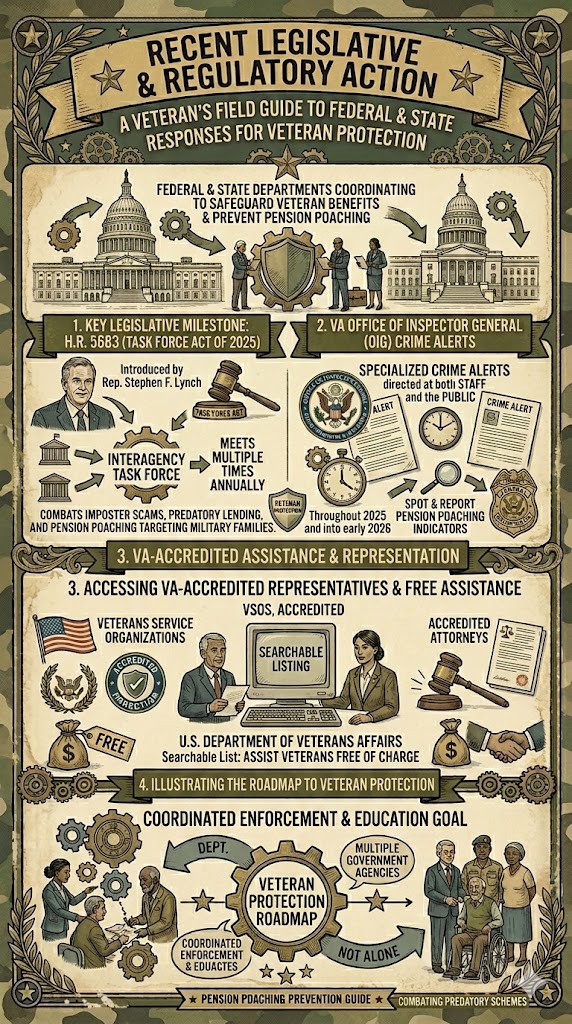
The surge in financial exploitation has prompted significant federal and state responses. The U.S. Department of Veterans Affairs and other departments play a crucial role in providing resources and support to veterans, helping to safeguard their benefits and prevent pension poaching:
- H.R. 5683 (Military Consumer Protection Task Force Act of 2025): Introduced by Rep. Stephen F. Lynch, this bill establishes an interagency task force meeting multiple times annually to combat imposter scams, predatory lending, and pension poaching targeting military families.
- VA OIG Fraud Alerts: Throughout 2025 and into early 2026, the VA Office of Inspector General published specialized crime alerts directed at both staff and the public to spot and report pension poaching indicators.
The U.S. Department of Veterans Affairs provides a searchable list of VA-accredited representatives, including Veterans Service Organizations, agents, and attorneys, who can assist veterans free of charge.
These efforts aim to coordinate enforcement and education across multiple government agencies rather than leaving veterans to navigate protection systems alone.
Example Scenario
Harold, age 78, is a Vietnam-era Army veteran living in an assisted living facility in rural Pennsylvania. He receives a modest VA disability pension and requires daily assistance with bathing and mobility, qualifying him for Aid and Attendance benefits.
Last month, a well-dressed man visited his facility claiming to be a veterans benefits advisor, offering to help Harold and his family members qualify for additional VA pension funds. The advisor charged Harold $5,500 upfront and transferred his $46,000 in retirement savings into an irrevocable trust, promising this would help him meet income limits for his VA pension claim. The scammer also interfered with the payment process, putting Harold’s benefit payments at risk.
Harold now faces a VA three-year look-back review that may determine he was ineligible, requiring repayment of all benefits received. He is also locked out of Medicaid eligibility for long-term care and cannot access his savings without severe penalty fees.
Frequently Asked Questions
What is veteran pension poaching?
Veteran pension poaching is a predatory financial scam where unethical advisors target elderly and disabled veterans to help them artificially qualify for VA pension benefits. Scammers transfer retirement savings into irrevocable trusts or expensive annuities, often charging illegal upfront fees up to $6,000. If discovered, the veteran—not the scammer—must repay all benefits to the federal government.
How much do veterans lose to pension poaching scams?
The average veteran victim loses approximately $4,300 per scam, but some lose far more, on top of owing the VA back pay for the fraudulent use of money.
Why are veterans targeted more than civilians for financial fraud?
Veterans are disproportionately targeted due to the consistency of their government compensation and disability payments. According to AARP, service members and veterans are significantly more likely to be targeted by fraudulent solicitations than civilians (35% versus 25%). Up to 86% of veterans have reported encountering benefits and charity-related scams.
Can someone legally charge me to file a VA benefits application?
No. By law, no one can charge a fee for preparing or filing an initial application for VA benefits. Free help is legally required to be available through VA-accredited individuals and Veteran Service Officers (VSOs). Any advisor demanding upfront fees or a percentage of your back-pay is operating illegally.
What happens if the VA discovers I restructured assets to qualify for pension?
The VA reviews a three-year look-back period for any assets transferred before a pension claim is filed. If the VA determines the financial restructuring was deceptive, the veteran is held legally responsible and must repay all distributed benefits to the federal government. Additionally, hiding assets frequently disqualifies veterans from Medicaid, leaving them unable to pay for long-term care.
How do I report a suspected veteran pension poaching scam?
Report suspicious activity, missing payments, or unverified advisors to the VA direct hotline at 1-800-827-1000 or file a complaint online or by telephone through FTC reporting portals. Always check the credentials of anyone offering assistance with your benefits. Never share VA.gov login credentials or allow benefits to be deposited into a third-party’s bank account. Only work with free, properly accredited Veteran Service Officers. Downloadable resources, important links, and official information are available on the VA website to help veterans avoid pension poaching scams. Access these resources to stay informed and protect your benefits.
What is the government doing to stop veteran pension poaching?
H.R. 5683 (Military Consumer Protection Task Force Act of 2025) establishes an interagency task force to combat imposter scams, predatory lending, and pension poaching targeting military families. The VA Office of Inspector General has published specialized fraud alerts throughout 2025 and 2026 to help identify poaching indicators. State-level agencies have also launched aggressive public awareness campaigns.
Practical Steps to Protect Yourself
Veterans and their families can take concrete steps to avoid pension poaching schemes:
- Never pay a fee for assistance completing or submitting a VA benefit application. Free help is legally required through VA-accredited individuals.
- Only work with properly accredited Veteran Service Officers (VSOs) who provide services at no cost.
- Never share VA.gov login credentials or allow benefits to be deposited into a third party’s bank account.
- Be cautious of unsolicited contact promising to help you qualify for benefits through financial restructuring.
- Take your time before making decisions or sharing personal information—do not rush into agreements or financial arrangements.
- Use available resources to verify advisors, report suspicious activity, and seek assistance if you have concerns about your benefits.
If you encounter suspicious activity, missing payments, or unverified advisors, report immediately to the VA direct hotline at 1-800-827-1000 or through FTC reporting portals.
Remember that only about 1 in 5 scams is ever officially reported, so your report helps protect other veterans from the same schemes.
 Benefits.com Advisors
With expertise spanning local, state, and federal benefit programs, our team is dedicated to guiding individuals towards the perfect program tailored to their unique circumstances.
Rise to the top with Peak Benefits!
Join our Peak Benefits Newsletter for the latest news, resources, and offers on all things government benefits.