














A Permanent Change of Station (PCS) is the government-ordered, long-term relocation of a service member from one duty station to another, typically lasting two to four years. The Department of Defense issues about 400,000 PCS orders a year.
Why This Update
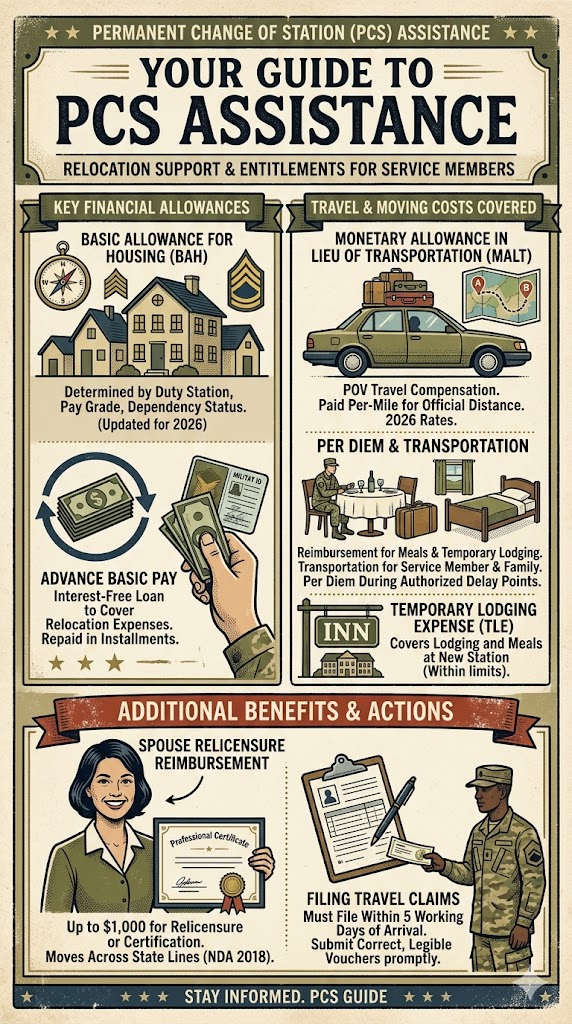
For 2026, key reimbursements include a MALT mileage rate of $0.205 per mile, a partial DLA of $1,002.71, and full DLA rates ranging from roughly $1,018.96 (E-1, no dependents) to $6,385.58 (O-7 and above, with dependents) after a 3.8% increase effective January 1, 2026.
What a PCS Actually Is (and Isn’t)
A PCS is a permanent reassignment — “permanent” meaning the assignment has no specified end date and no return to the old station in the orders. That’s the definition straight from the Joint Travel Regulations, Appendix A.
In plain English: you’re packing up your household, your family, and your life, and moving to a new duty station where you’ll live and work for the next two to four years.
A few distinctions worth nailing down, because they affect your pay and entitlements:
- PCS vs. TDY (Temporary Duty): TDY is short-term — usually under six months — and you keep your permanent duty station. TDY gets per diem, but no DLA, no household goods shipment, no TLE.
- PCS vs. Deployment: Deployments are mission-specific and usually capped at 179 days. Any order beyond 179 days at a forward location typically has to be recharacterized as a PCS, because that’s when PCS pay and allowances kick in.
- PCS vs. PCA (Permanent Change of Assignment): A PCA is a reassignment inside the same post — same duty station, new unit. No move, no PCS entitlements.
If your orders say “PCS,” you’re entitled to the full package of pay and allowances under JTR Chapter 5.
The 2026 PCS Entitlements, in One Place
Here’s every allowance and reimbursement you should be looking at for a 2026 move:
Dislocation Allowance (DLA) — the biggest flat payment
DLA is a flat, non-taxable, lump-sum payment designed to cover the miscellaneous costs of setting up a new household: deposits, utility connections, a new set of whatever the last place had built in. It’s not receipt-based. You don’t submit expenses. You get it because you moved.
The amount depends on pay grade and dependency status. Both go up for 2026 — DoD applied a 3.8% increase effective January 1, 2026.
2026 DLA range:
- Lowest: ~$1,018.96 (E-1, without dependents)
- Highest: ~$6,385.58 (O-7+, with dependents)
- Partial DLA (forced move from government quarters, no PCS orders): $1,002.71
Who does NOT get DLA:
- Service members on their first PCS with no dependents
- Anyone ordered to active duty for the first time without dependents
- Anyone assigned to single-type government quarters (barracks, a ship) at the new station with no dependents
- Anyone who already drew a DLA in the same fiscal year (with limited exceptions under JTR par. 050509)
Pro tip most finance offices won’t volunteer: you can request an advance of up to 80% of your estimated DLA 10–15 days before you move. Submit the request through your losing installation’s finance office with your commander’s approval. If base housing isn’t immediately available at the new station — common at places like JBLM — that advance is what keeps a credit card from eating your first month’s rent.
MALT (Monetary Allowance in Lieu of Transportation) — driving to the new base
If you drive your personally owned vehicle (POV) to the new duty station, you get reimbursed per mile.
- 2026 MALT rate: $0.205 per mile, per authorized vehicle
- The rate is the same whether one person or four are in the car — MALT isn’t per passenger, it’s per vehicle.
- Mileage is calculated from the Defense Table of Official Distances (DTOD), not your actual odometer. If your GPS routes you through a scenic detour, that’s on you.
- Authorized travel days: one day for the first 400 miles, then one day per additional 350 miles. An extra day is granted if the final leg is 51+ miles.
Tolls, ferries, and bridge fees are separately reimbursable with receipts — don’t lose those.
A family moving from Fort Liberty, NC to Fort Cavazos, TX (roughly 1,350 miles) will see about $276 in MALT for one vehicle, or about $553 for two.
Per Diem — meals and lodging on the road
While traveling, you get a daily allowance for meals, lodging, and incidentals.
- FY2026 standard CONUS rate: approximately $109/day ($70 lodging + $39 M&IE), adjusted by location
- Service member: 100% of the rate
- First dependent: 75%
- Each additional dependent: 50%
Per diem is paid on a whole-day calendar basis for authorized travel time. Higher-cost localities (most major metros) have higher lodging caps — check the DoD Per Diem Rate Lookup for your specific route.
TLE / TLA — lodging while you wait for permanent housing
Temporary housing has two flavors depending on where you’re moving:
- TLE (Temporary Lodging Expense) — for CONUS moves. Up to 14 days combined at the old and new duty station (extendable to 60 days in DoD-specified housing-shortage areas). Per Chapter 5 of the JTR.
- TLA (Temporary Lodging Allowance) — for OCONUS moves. More flexible, can run 30, 60, or even 90 days while you hunt for housing abroad. Requires updated lodging receipts every 10–15 days.
Overseas assignments also trigger COLA (Cost of Living Allowance) and OHA (Overseas Housing Allowance) once you’re in place — separate from the PCS entitlements, but worth knowing about now.
Weight Allowance — how much the government will ship
The government will ship your household goods (HHG) up to a weight cap set by rank and dependency. Go over, and you pay every excess pound yourself.
2026 weight allowances (with dependents, CONUS):
- E-1 to E-3: 5,000–8,000 lbs
- E-5 with dependents: 9,000 lbs
- E-7 with dependents: 13,000 lbs
- O-3 with dependents: 14,500 lbs
- O-6 with dependents: 18,000 lbs
- O-10: 18,000 lbs (cap)
Professional gear (PBP&E, or “pro-gear”) — uniforms, trade tools, specialized equipment required for your duties — is excluded from the weight limit when properly documented and inventoried. Furniture associated with pro-gear (bookcases, desks, file cabinets) does not qualify and counts against your allowance. Personal computer equipment is also excluded from pro-gear.
Excess weight charges typically run $1+ per pound over the limit, and a single overage can easily cost four figures.
Advance Pay and Other PCS Cash
- Advance Basic Pay: an interest-free loan of up to three months of basic pay, repaid in 12 equal monthly installments starting the month after disbursement.
- Spouse Relicensure Reimbursement: up to $1,000 per move for occupational relicensing and certification costs when a PCS crosses state lines, under the 2018 National Defense Authorization Act.
- Personally Procured Move (PPM / DITY) Reimbursement: if you move yourself, you’re reimbursed at 100% of what the government would have paid a contractor. Any surplus after expenses is yours, but it’s taxable income.
CONUS vs. OCONUS PCS: What Actually Changes
| Factor | CONUS PCS | OCONUS PCS |
| Temporary lodging | TLE, capped at 14 days | TLA, typically 30–90 days |
| Passport requirement | No | Yes (official or no-fee) |
| Command sponsorship | Not required | Required for dependents to accompany |
| Medical/dental screening | Not required | Mandatory for service member and family |
| POV shipment | Not typically covered | One POV shipped at government expense |
| Pet shipment | Your responsibility | Your responsibility + import rules, quarantine, microchip, vaccines |
| COLA / OHA | No | Yes, once at new station |
The biggest practical difference: an OCONUS PCS is not a logistics challenge, it’s an approval process. You cannot just schedule movers. The gaining command has to approve your family as authorized to accompany you, and every dependent needs the passport, immunizations, and medical clearance finalized before a single box gets packed. Start that paperwork the day orders arrive.
Your PCS Timeline, Start to Finish
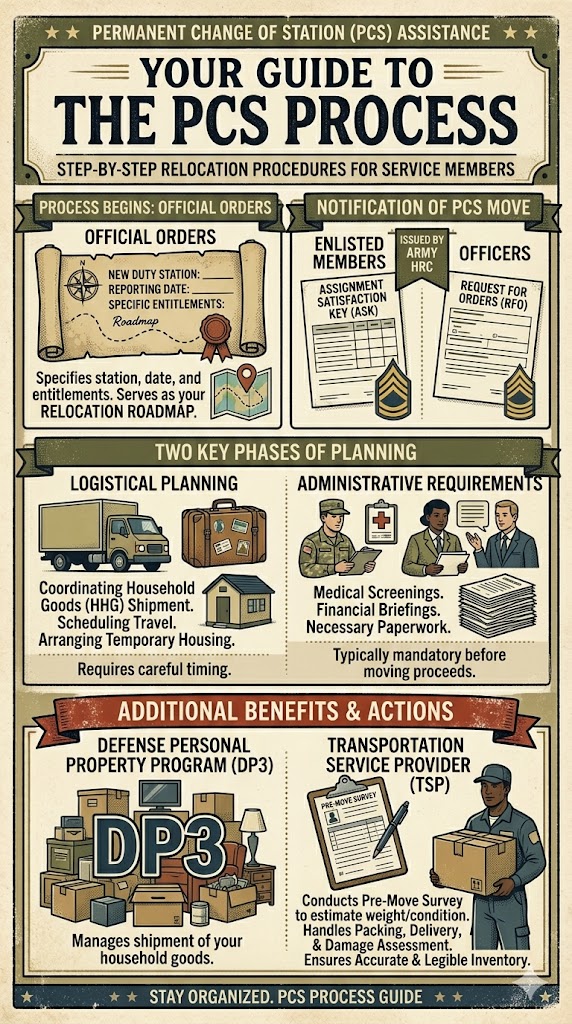
Most service members get PCS orders 60–120 days before the report date. Here’s what actually happens in that window.
- Notification and orders. Enlisted Army members receive an Assignment Satisfaction Key (ASK); officers get a Request for Orders (RFO). The Air Force generates a DAF 899 through the Virtual Out-Processing Application. You can’t schedule anything until the orders are authenticated.
- Levy briefing. Required reassignment briefing covering the process. Some posts do it in person, others online.
- Transportation appointment. Book with your installation’s Transportation Office (TMO). As of 2026, this goes through the legacy Tender of Service program — the Global Household Goods Contract was canceled in June 2025, and DoD stands up the new Personal Property Activity at Scott AFB on May 1, 2026.
- House-hunting. Submit DA Form 4787-R (Army) or equivalent. Permissive TDY of up to 10 days (separation/retirement can get up to 20) allows you to look for housing without burning leave.
- Pack and load. Household goods ship through the Defense Personal Property System (DPS).
- Travel. Drive or fly. Keep receipts for per diem, tolls, and any reimbursable expenses.
- Report and in-process. File your PCS travel voucher within 5 working days of arrival. File any household goods damage claims through DPS within 75 days of delivery.
Common PCS Mistakes That Cost Real Money
A short list of the ones a finance office sees over and over:
- Going over your weight allowance. Declutter before the movers arrive, not after. Every pound over is out of pocket.
- Skipping the DLA advance. Free money you can get early.
- Not being present for pack-out and delivery. If you’re not there to point at the china hutch and the TV, nobody’s checking how they get boxed. Take photos.
- Missing the 5-day voucher deadline. DFAS will not prioritize a late claim.
- Losing toll and ferry receipts. Those are separately reimbursable — keep them.
- Signing the inventory without inspecting. Never sign without noting damage or missing items. You lose most claim rights once the paperwork is signed clean.
- Forgetting the spouse relicensure reimbursement. Up to $1,000 per cross-state move — your spouse earns it, not you, but it’s claimed through your PCS process.
Frequently Asked Questions
How long does a PCS last?
A PCS assignment typically lasts two to four years. The exact tour length depends on service branch, duty station, and mission requirements. Overseas tours are often shorter than CONUS assignments.
How much is DLA in 2026?
2026 DLA rates increased 3.8% over 2025. Rates range from about $1,018.96 for E-1 without dependents to approximately $6,385.58 for O-7 and above with dependents. Partial DLA is $1,002.71. The Defense Travel Management Office publishes the full table at travel.dod.mil.
What is the 2026 MALT mileage rate?
The 2026 MALT rate is $0.205 per mile, per authorized vehicle. The rate is the same regardless of how many authorized travelers are in the vehicle.
Is a PCS the same as a deployment?
No. A deployment is a mission-specific assignment — typically training, combat operations, or a defined task — and is usually capped at 179 days. A PCS is a permanent reassignment to a new duty station with full household relocation benefits. Deployments generally do not include DLA, household goods shipment, or TLE.
Who is eligible for Dislocation Allowance?
Any service member executing a PCS move who is not assigned to single-type government housing (like a barracks) at the new station is generally eligible. Service members on their first PCS without dependents, or those ordered to active duty the first time without dependents, are typically not eligible.
Can I request an advance on my PCS entitlements?
Yes. DLA and some other PCS reimbursements can be advanced up to 80% of the estimated payment when you request it through your losing installation’s finance office 10–15 days before the move, with commander approval. The remaining 20% is paid after you file the final travel voucher at the new station.
How much is the military willing to ship for me?
Weight allowances range from 5,000 pounds for E-1 to 18,000 pounds for O-10, with higher allowances for service members with dependents. Professional gear (pro-gear, or PBP&E) is shipped separately and does not count against the weight allowance when properly documented.
How long is TLE?
For CONUS PCS moves, Temporary Lodging Expense covers up to 14 days combined between the old and new duty stations. In DoD-designated housing-shortage areas, TLE can be extended up to 60 days. For overseas moves, Temporary Lodging Allowance replaces TLE and is typically authorized for 30 to 90 days.
How long do I have to file my PCS travel voucher?
Service members are required to file their PCS travel claim within 5 working days of arrival at the new duty station. Household goods damage claims are filed separately through the Defense Personal Property System within 75 days of delivery.
Does the military pay for my final move after separation or retirement?
Yes. Retirees have one year from the date of retirement on their orders to complete a final PCS move to any U.S. location. Separating service members typically have six months. Some senior-level retirees qualify for a “last move home” option with different rules.
The PCS for Veterans: Your Final Move
This is where the PCS conversation connects directly to veterans benefits — and it’s the piece most PCS guides miss.
Your final PCS is the move the government pays for when you separate or retire. It’s a real entitlement, not a gift, and the rules are different from an active-duty PCS.
- Retirees get one year from the retirement date on their orders to complete the final move and can choose any location in the U.S. For OCONUS final moves, you pay any additional cost above what the equivalent CONUS move would have been.
- Separating service members typically have six months for the final PCS from the final-out date.
- SES and senior retirees with “last move home” entitlements can choose any U.S. location at least 50 miles from the separating duty station — but are not eligible for TLE, a house-hunting trip, or certain other PCS benefits.
- Permissive TDY of up to 20 days is available for job-search and residence-search activities before separation (DAFI 36-3009 for Air Force).
- VA home loans can make a real difference when settling down. Take advantage of the benefits offered to you for your service.
 Benefits.com Advisors
With expertise spanning local, state, and federal benefit programs, our team is dedicated to guiding individuals towards the perfect program tailored to their unique circumstances.
Rise to the top with Peak Benefits!
Join our Peak Benefits Newsletter for the latest news, resources, and offers on all things government benefits.