














In 1956, the Social Security Act was amended to allow for cash benefits to disabled workers between ages 50–65 and to certain disabled adult children. Child’s benefits are also available for dependent children with disabilities, provided they meet specific criteria, such as being under age 18 or, in some cases, continuing into adulthood if the disability began before age 22.
Over time, eligibility expanded to include disabled workers of any age and their dependents. Social Security programs are designed with strict standards to help prevent fraud and ensure Social Security disability benefits go to truly eligible individuals. Eligibility is based on the legal definition of disability as established by Social Security rules. Disability Determination Services (DDS) review medical information, conduct assessments, and determine disability for both children and adults.
Introduction to Social Security
Administered by the Social Security Administration (SSA), the federal program is funded through paid Social Security taxes collected from workers and employers across the country. Social Security offers two main types of disability benefits: Social Security Disability Insurance (SSDI) and Supplemental Security Income (SSI).
SSDI benefits are available to individuals who have a qualifying work history and have paid Social Security taxes through their employment. This Social Security disability insurance (SSDI) program is intended for people whose disabilities prevent them from working on a regular basis. On the other hand, Supplemental Security Income (SSI) is a needs-based program that provides benefits to individuals with disabilities who have limited income and resources, regardless of their work history. Both federal programs aim to offer essential assistance to those who need it most, ensuring that people with disabilities have access to the support and benefits they deserve.
Who Qualifies for SSDI Today?

To qualify for Social Security Disability Insurance, you must meet all of the following:
- You have a medically determinable physical or mental impairment that significantly limits your ability to perform basic work-related activities and prevents you from engaging in “Substantial Gainful Activity” (SGA). The Social Security Administration evaluates the extent to which your condition limits your ability to work, based on the legal definition of disability and how it impacts a person’s daily functioning.
- Your condition is expected to last at least 12 months or result in death;
- You are under full retirement age (currently between 66 and 67, depending on your birth year);
- You have earned enough work credits by paying into the Social Security system via payroll (FICA) or self-employment taxes. A person may qualify for benefits based on their own work record or, in some cases, on a parent’s record if they are an adult disabled child.
A simple letter from your doctor is not enough — the Social Security Administration requires detailed medical records, such as treatment records, objective test results, and clinical notes that support your limitations. A spouse may also be eligible for benefits based on the primary beneficiary’s work history.
What Social Security Disability Insurance Actually Is
Social Security Disability Insurance is a federal program funded by workers’ payroll taxes. It:
- Is administered by the SSA, with state disability agencies, known as Disability Determination Services (DDS), assisting in medical evaluations, reviewing medical information, and making disability determinations;
- Provides benefits only to individuals who have paid into the system and meet strict medical and non-medical requirements;
- Does not provide benefits for temporary or short-term disability.
Applying for SSDI is not like filing a regular insurance claim — it’s a complex, multi-step process involving detailed documentation, medical evidence, and often appeals. Seeking expert help can assist applicants in navigating the process and understanding eligibility requirements.
Application Process
Applying for Social Security Disability Insurance (SSDI) involves several important steps. First, you’ll need to determine if you are eligible for SSDI benefits by meeting the Social Security Administration’s definition of disability and having a sufficient work history. You can start your application process online, by phone, or by visiting your local SSA office. During the application, you’ll be asked to provide detailed information about your medical condition, work history, and education to help the SSA assess your eligibility.
Once your application is submitted, the SSA will review your case and make a determination about your eligibility for benefits. If your application is denied, you have the right to appeal the decision and request a hearing with an Administrative Law Judge (ALJ). It’s important to be thorough and accurate in your application, as providing complete information about your disability, work history, and education can help the SSA determine if you qualify for SSDI benefits.
How Much Will You Receive?

As of 2025, SSDI provides monthly benefits to qualifying individuals. The average monthly SSDI benefit for disabled workers is approximately $1,537, though this amount varies based on your social security earnings record. Dependents may also qualify:
- Eligible spouses: average of ~$430/month. Monthly payments are also available to certain dependents, including those who qualify based on a parent’s record.
- Eligible children: average of ~$480/month. Monthly payments are also available to certain dependents, including those who qualify based on a parent’s record.
Your benefit amount is based on your lifetime average earnings under Social Security, as shown in your official social security earnings record. Once approved, the SSA will send you an Award Notice with the benefit amount and the disability onset date. When you reach full retirement age, your disability benefits automatically convert to retirement benefits.
Benefit Reductions
Your SSDI payment may be reduced if you are receiving:
- Workers’ compensation;
- Public disability benefits;
- Certain pensions not covered by Social Security.
Benefits from other programs, such as workers’ compensation or public disability programs, may also affect your SSDI benefits.
Waiting Period
You must be disabled for five full months before benefits begin. Generally, your first payment arrives in the sixth full month after disability onset. However, if your disability began more than 17 months before you applied, you may be eligible for up to 12 months of back pay, which covers retroactive benefits for periods in the past before your application date.
If an attorney helps you win your claim, their SSA-approved fee is usually deducted from any back pay — you do not pay them directly.
When Will You Be Paid?
SSDI provides monthly payments, and your monthly payment date depends on your birth date:
- Born on the 1st–10th: Paid on the 2nd Wednesday
- Born on the 11th–20th: Paid on the 3rd Wednesday
- Born on the 21st–31st: Paid on the 4th Wednesday
If you also receive Supplemental Security Income (SSI), your SSDI monthly payments are paid on the 3rd of the month, regardless of birth date. Spouses’ monthly payments are based on the wage earner’s birth date.
If a payment date falls on a weekend or holiday, you will be paid on the prior business day.
How Will You Be Paid?
You can apply online for SSDI and SSI benefits and set up your preferred payment method through the SSA website.
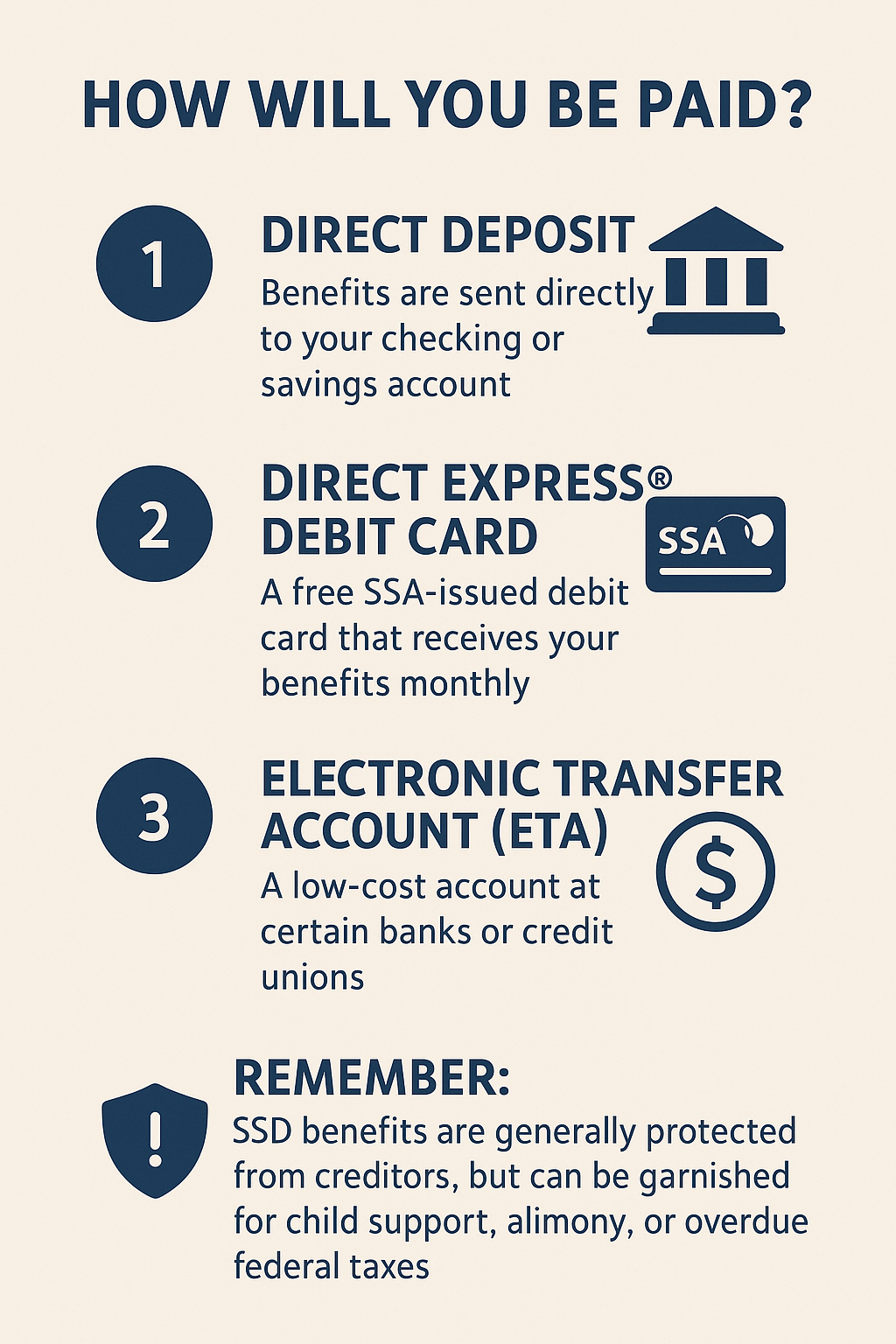
The SSA no longer sends paper checks except in rare situations. You can choose from the following options for both SSDI and SSI benefits recipients:
- Direct Deposit – Benefits are sent directly to your checking or savings account.
- Direct Express® Debit Card – A free SSA-issued debit card that receives your benefits monthly.
- Electronic Transfer Account (ETA) – A low-cost account at certain banks or credit unions, ideal for those who do not have a standard bank account.
Remember: SSD benefits are generally protected from creditors, but can be garnished for child support, alimony, or overdue federal taxes. Survivors benefits may also be subject to similar garnishment rules.
Appeals Process
If your SSDI application is denied, you are not out of options. The appeals process gives you several opportunities to have your case reviewed. The first step is to request a reconsideration, where your application is reviewed again by the SSA. If you are still denied, you can request a hearing before an Administrative Law Judge (ALJ), who will evaluate your case in more detail.
You can also ask for a review by the Appeals Council, which will examine the decision for any errors or overlooked evidence. Throughout the appeals process, you can choose to represent yourself or seek help from a disability attorney. It’s crucial to submit any new and relevant evidence that supports your claim for benefits. If you exhaust all administrative appeals and are still denied, you have the right to file a lawsuit in federal court to continue pursuing your SSDI benefits.
At Benefits.com, we aim to point you in the right direction towards all the benefits available to you. Take our free eligibility quiz today to get started!
 Benefits.com Advisors
With expertise spanning local, state, and federal benefit programs, our team is dedicated to guiding individuals towards the perfect program tailored to their unique circumstances.
Rise to the top with Peak Benefits!
Join our Peak Benefits Newsletter for the latest news, resources, and offers on all things government benefits.