









We are privately owned and not affiliated or endorsed by any government agency.

Take the Benefits Quiz

Chapter 35 Benefits for Veterans: Your Complete Guide to Dependents Educational Assistance

Chapter 35 benefits provide a crucial lifeline for educational and career advancement opportunities. Officially known as the Survivors’ and Dependents’ Educational Assistance (DEA) program, these benefits are administered by the Department of Veterans Affairs and the Department of Veterans, which oversee programs like Chapter 35 to support military families. These agencies play a key role in providing access to quality education even after significant sacrifices in service.

In addition to Chapter 35, the dependents education program and other education and training opportunities are available through the Department of Veterans Affairs and the Department of Veterans to help eligible dependents and survivors pursue their educational goals. Understanding these benefits can unlock thousands of dollars in educational support for eligible dependents and survivors.

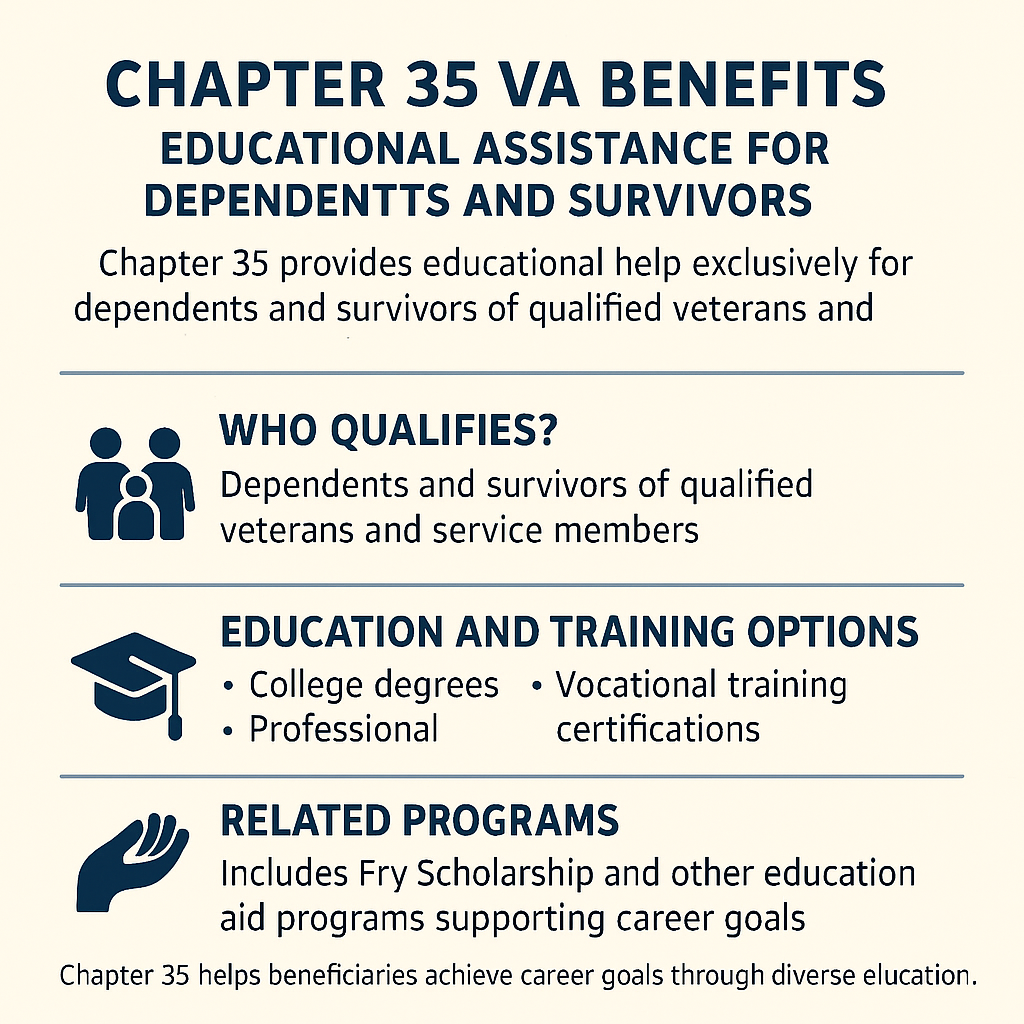
What Are Chapter 35 VA Benefits?

Chapter 35 VA Benefits infographic

Chapter 35 benefits represent one of the most comprehensive dependents educational assistance programs available. Unlike traditional GI Bill programs that primarily serve veterans and active service members, Chapter 35 is exclusively designed for dependents and survivors of qualified veterans and service members.

The program offers education and training opportunities, covering a wide range of educational pursuits to support beneficiaries with different career goals. Whether you’re seeking a college degree, vocational training, or professional certification, Chapter 35 benefits can help support your educational journey.

Chapter 35 is one of several education assistance programs available, including the Fry Scholarship for children and surviving spouses.

Who Qualifies for Chapter 35 Benefits?

Veteran Eligibility Requirements

For Chapter 35 benefits for veterans’ dependents to be available, the veteran or service member must meet specific criteria:

  • 100% Permanent and Total Service-Connected Disability: The veteran is considered totally and permanently disabled due to a service related condition, which may have resulted from injuries sustained during armed conflict, and is rated as completely disabling by the VA
  • Death in Line of Duty: The service member’s passing, referred to as the veteran’s death, occurred while on active duty
  • Death from Service-Connected Disability: The veteran’s death resulted from a service related condition
  • Missing in Action (MIA): Listed as MIA for more than 90 days
  • Captured or Detained: Forcibly detained by hostile forces for more than 90 days

Dependent Eligibility

Eligible family members include:

  • Spouses of qualifying veterans
  • Biological children (A child may be eligible for educational benefits under Chapter 35)
  • Stepchildren
  • Adopted children

Important Age and Time Limits

For Children:

  • Benefits typically available from age 18 (or high school completion) until age 26
  • Extensions possible up to age 31 in specific circumstances
  • Marriage generally doesn’t affect eligibility

For Spouses:

  • 10 years from VA eligibility determination or veteran’s death
  • 20 years for surviving spouses of service members who died on active duty

Note: A surviving spouse is eligible for VA education benefits for up to 20 years if the service member died while on active duty.

Chapter 35 Benefit Payment Rates (2024-2025)

Understanding current payment rates helps families plan their educational expenses effectively. Payment rates are determined by the number of credit hours and training time enrolled, as well as the tuition and fees for the program. The VA updates these rates annually, with the current rates effective from October 1, 2024, through September 30, 2025.

College and University Programs

  • Full-time enrollment: $1,536 per month
  • Three-quarter time: $1,214 per month
  • Half-time: $890 per month
  • Less than half-time: $890 per month (or tuition cost, whichever is less)
  • Quarter-time or less: $384 per month (or tuition cost, whichever is less)

Note: Your enrollment status for VA educational benefits is determined by the number of credit hours you are taking. Full-time, three-quarter time, and half-time statuses are based on specific credit hour thresholds set by your school, which directly affect your monthly entitlement and rate of pursuit (ROP). Be sure to check your institution’s credit hour requirements to understand how your benefit amount will be calculated.

On-the-Job Training and Apprenticeships

The payment structure for on-the-job training and apprenticeships is based on both the training time and the type of training program you are enrolled in. Payment amounts decrease over time to encourage program completion:

  • Months 1-6: $975 per month
  • Months 7-12: $733 per month
  • Months 13-18: $481 per month
  • After 18 months: $245 per month

Specialized Training Programs

Correspondence Training (Spouses Only): 55% of established lesson costs

Special Restorative Training: $1,536 per month for full-time enrollment

Licensing and Certification: Up to $2,000 for test fees

How to Apply for Chapter 35 Benefits

The application process for Chapter 35 benefits for veterans’ dependents is straightforward but requires careful attention to detail. Applicants can seek help from veterans services, the Virginia Department, and the Virginia Military Survivors program for guidance on accessing education assistance and educational benefits.

Required Documents

Gather these essential documents before starting your application:

  • Your Social Security Number
  • Sponsor’s Social Security Number or VA file number
  • School or training facility information
  • Personal education history
  • Bank account details for direct deposit
  • VA documentation of sponsor’s disability status

Application Steps

  1. Complete VA Form 22-5490 (Dependents’ Application for VA Education Benefits)
  2. Submit online at VA.gov or mail the completed form
  3. Receive Certificate of Eligibility (COE) from the VA
  4. Provide COE to school veterans’ certification official
  5. Begin receiving benefits after enrollment certification

Pro Tip: Apply several months before your intended start date to ensure processing time doesn’t delay your education plans.

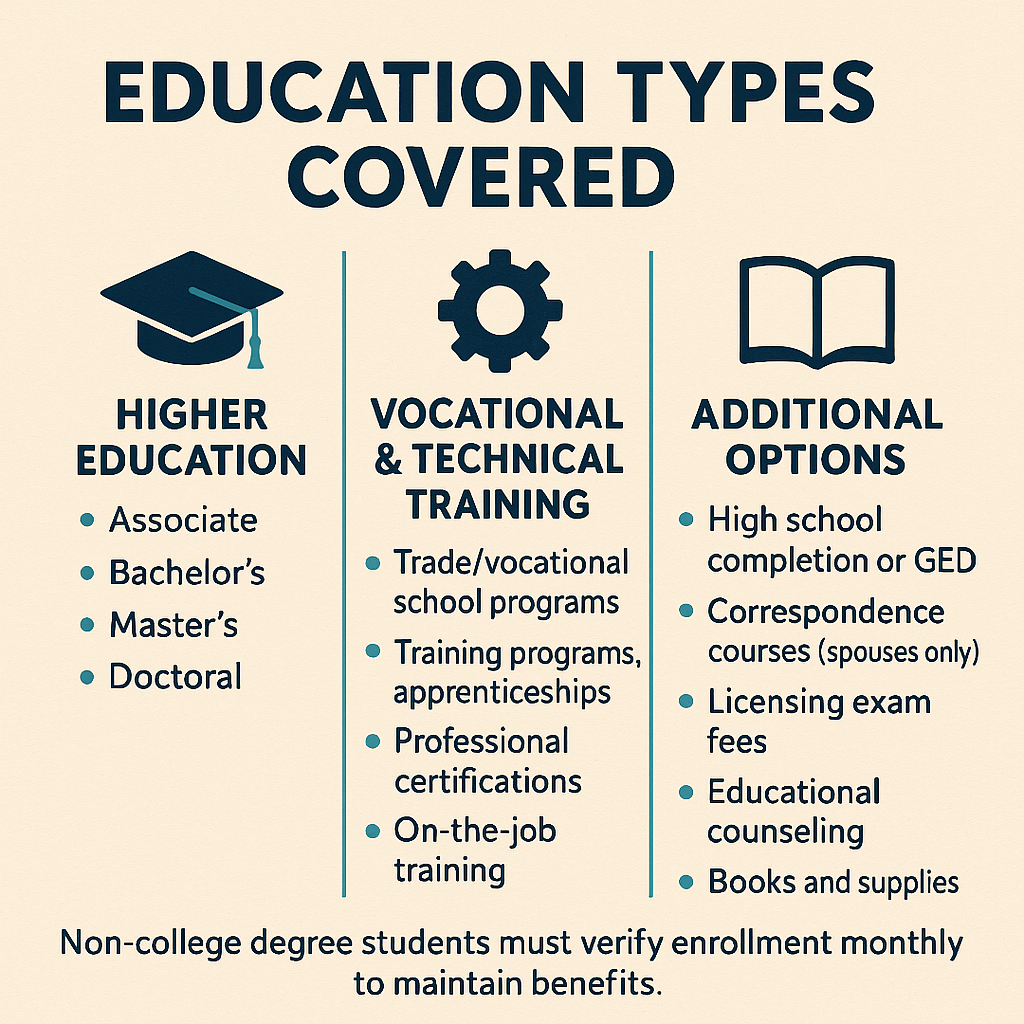
Types of Education Covered

Chapter 35 Education Types infographic

Higher Education

  • Associate degrees
  • Bachelor’s degrees
  • Master’s degrees
  • Doctoral programs

Vocational and Technical Training

  • Trade school programs
  • Vocational school
  • Training programs
  • Professional certifications
  • Apprenticeship programs
  • On-the-job training

Additional Options

  • High school completion or GED
  • Correspondence courses (spouses only)
  • Licensing examination fees
  • Educational counseling services
  • Books and supplies

Students enrolled in non-college degree programs must verify their enrollment each month to access DEA benefits.

Key Differences from Other VA Benefits

While GI Bill benefits, such as the Post-9/11 GI Bill, Fry Scholarship, and transferred benefits, often cover tuition, housing, and additional education-related expenses for veterans and their dependents, Chapter 35 (DEA) has different eligibility requirements and generally provides a monthly stipend rather than direct payment for tuition or housing.

Chapter 35 vs. Post-9/11 GI Bill

  • Chapter 35: Exclusively for dependents, no minimum service requirement
  • Post-9/11 GI Bill: Primarily for veterans, with transfer options to dependents. Note: Children or surviving spouses of service members or members of the selected reserve who died on or after September 11, 2001, may be eligible for the Fry Scholarship.

Unique Features

  • No housing allowance (unlike Post-9/11 GI Bill)
  • Can combine with other financial aid (scholarships, grants)
  • Cannot use multiple VA education benefits simultaneously
  • Maintains eligibility regardless of marriage status (for children)

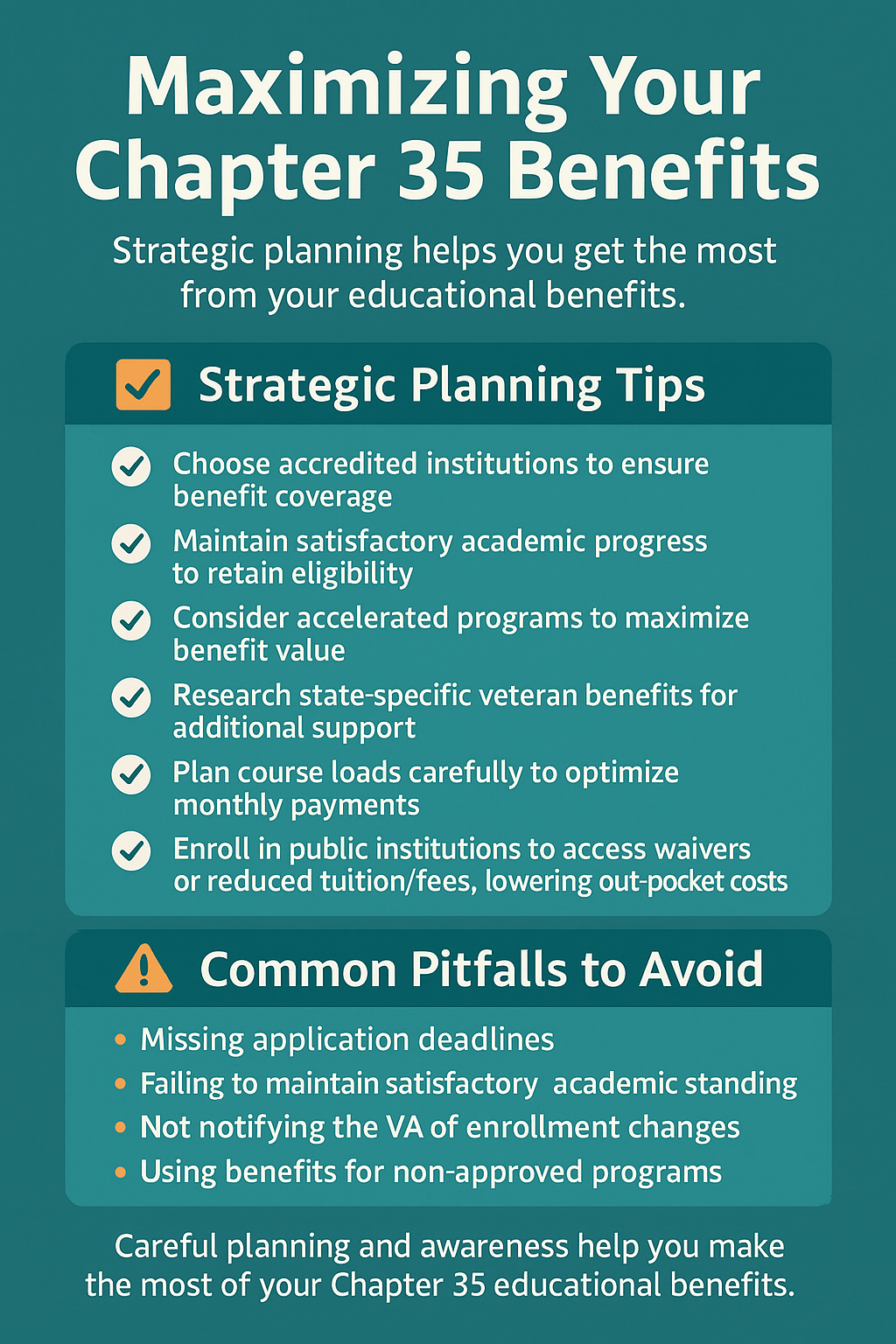
Maximizing Your Chapter 35 Benefits

Maximize Chapter 35 Benefits infographic

Strategic Planning Tips

  • Choose accredited institutions to ensure benefit coverage
  • Maintain satisfactory academic progress to retain eligibility
  • Consider accelerated programs to maximize benefit value
  • Research state-specific veteran benefits for additional support
  • Plan course loads carefully to optimize monthly payments
  • Consider enrolling in a public institution, as many VA education benefit programs and state scholarships offer waivers or reduced tuition and fees at public institutions of higher education. This can significantly lower your out-of-pocket costs.

Common Pitfalls to Avoid

  • Missing application deadlines
  • Failing to maintain satisfactory academic standing
  • Not notifying the VA of enrollment changes
  • Attempting to use benefits for non-approved programs

Special Considerations and Resources

Study Abroad Programs

Generally not covered unless required as part of a stateside program.

Online and Distance Learning

Fully supported for eligible programs and institutions.

Non-Resident Tuition

Many schools waive out-of-state tuition for Chapter 35 beneficiaries.

Additional Support Services

  • Career counseling through VA
  • Tutoring assistance programs
  • Mental health support services
  • Financial planning resources

The Long-Term Impact of Chapter 35 Benefits

Chapter 35 benefits for veterans create lasting positive impacts that extend far beyond individual education. These benefits:

  • Honor military service through family support
  • Break cycles of economic hardship
  • Create generational educational advancement
  • Strengthen military communities
  • Contribute to national workforce development

Research consistently shows that education benefits for military families lead to higher lifetime earnings, improved career satisfaction, and stronger community engagement.

Conclusion

If you’re eligible for Chapter 35 benefits, don’t wait to explore your options. The combination of financial support, educational flexibility, and career counseling services provides a comprehensive foundation for achieving your educational and professional goals. 

Allow us to guide you through the process of receiving benefits you deserve. Begin today by taking our free medical evidence screening, at Allveteran.com.

Benefits.com Advisors

With expertise spanning local, state, and federal benefit programs, our team is dedicated to guiding individuals towards the perfect program tailored to their unique circumstances.

Rise to the top with Peak Benefits!

Join our Peak Benefits Newsletter for the latest news, resources, and offers on all things government benefits.


Related Articles

x