














Applying for Supplemental Security Income (SSI) for a child involves meeting strict medical and financial criteria.
Medically, eligibility is based on the child’s disability—specifically, the child must have a severe physical or mental condition significantly limiting activities, expected to last at least one year or result in death. Children under age 18 can qualify for SSI benefits if they are disabled or blind.
Financially, eligibility considers the family’s income and resources through a process called ‘parental deeming.’ Supplemental Security Income provides monthly payments to help pay for basic needs like medical care, food, clothing, and shelter.
The application process includes completing a Child Disability Report, attending an interview, and submitting comprehensive medical, educational, and financial documentation. Initial decisions typically take 3-5 months, and denials can be appealed. Ongoing eligibility is monitored through periodic Continuing Disability Reviews, with a crucial re-evaluation at age 18.

Why This Update
Social Security applications can be tricky to figure out, and we want to make sure you have the most up-to-date information!
Medical Criteria: What Conditions Are Eligible for SSI?
A child’s condition must significantly limit their activities and either last, or be expected to last, for at least one year or result in death. The Social Security Administration (SSA) defines a child as disabled if they have a medically determinable physical or mental impairment that results in marked and severe functional limitations. This standard is strict and designed to help ensure that children with the most serious disabilities may receive support through SSI benefits.
To be considered for SSI benefits, a child must be under age 18, or if under age 22, be a student regularly attending school.
Common qualifying conditions for Supplemental Security Income include neurological disorders such as cerebral palsy, mental health conditions like autism spectrum disorder with significant support needs, developmental conditions including Down syndrome, and chronic illnesses such as cystic fibrosis.
State Disability Determination Services (DDS) evaluate all medical evidence, including records, reports, and documentation of functional limitations. They assess how the condition impacts the child’s ability to function in daily life, including learning, movement, and social interaction.
Financial Criteria: The Role of Parental Deeming
Parental deeming is a complex financial evaluation where a portion of the family’s income is considered available to the child under deeming eligibility guidelines. When an eligible child lives in the same household as their parents or guardians, deemed income from parents—including adoptive parents and stepparents—is used to determine the child’s SSI eligibility. The living situation, such as whether the child lives with a single parent or other children in the home, affects the amount of SSI income and monthly benefit received.
The SSA evaluates both earned income and unearned income, and the child’s income is also factored into eligibility. However, certain income types are excluded, such as SNAP benefits and TANF assistance, as well as portions of other income. Countable parental income is reduced by allowances for other children without disabilities and the parents themselves. Students under 22 can exclude up to $2,410 of monthly earnings from SSI income calculations, with an annual limit of $9,730.
For 2026, the maximum federal Supplemental Security Income monthly payment amount for an eligible individual, including a child, is $994. The parental deeming income allocation for each ineligible child in the household and each ineligible parent in the household is $497 per month.
Parental deeming generally ends when a child turns 18, marries, or no longer lives with their parents. At that point, only the adult child’s income and resources are considered, and the family’s income and savings are no longer factored into the benefits assessment. SSI income is not taxed, and the amount received depends on the child’s living situation and income.
SSI Benefits Application Process
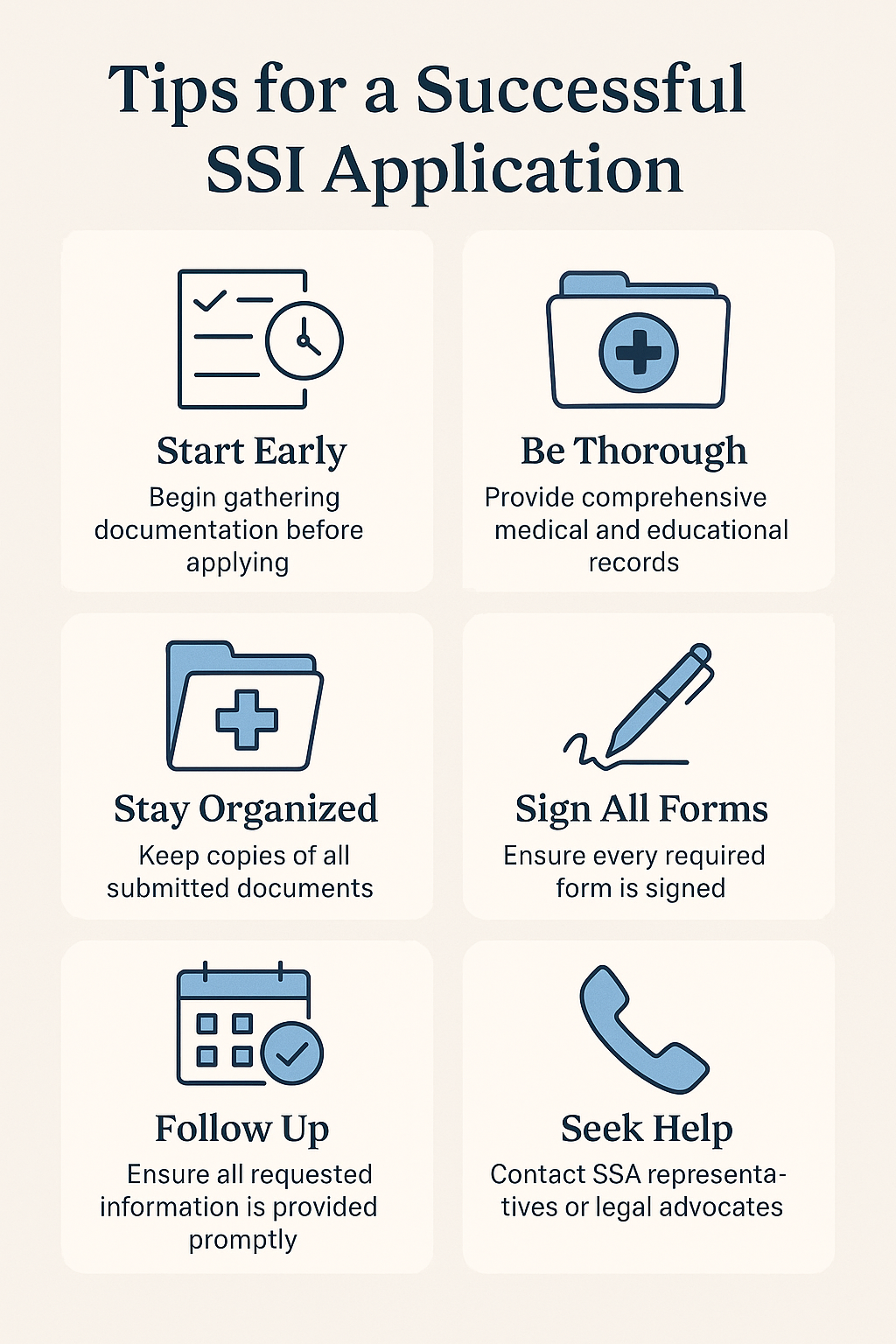
Begin by completing the Child Disability Report (SSA-3820-BK) online. Provide detailed information about the child’s condition, daily functioning, and medical history. This report gives the SSA a comprehensive picture of how the disability affects the child’s everyday life. Be thorough and specific when describing limitations and challenges.
After submitting the disability report, an SSI representative will contact you within 3-5 business days to schedule an interview. During this interview, you’ll review finances and complete the formal SSI application (Form SSA-8000). You will receive a copy of the filled-out application for your signature.
Gather comprehensive documentation beforehand, including the child’s birth certificate, medical records, educational records such as Individualized Education Programs (IEPs) or 504 plans, and detailed financial information for all household members. Having these documents ready will help the process move more smoothly. The SSA will make copies and return the original documents to you.
As part of the review process, the SSA may ask for follow-up information after the application is completed, including a Functional Assessment form, if the SSA believes more information is needed to determine eligibility. Be prepared for potential Consultative Examinations (CEs) if the DDS determines additional medical evidence is needed.
The initial decision process typically takes 3 to 5 months from the date of application, though individual timelines can vary. The SSI application process can take a long time, and many applications are initially rejected.

Appeals Process and Continuing Disability Reviews
If an initial SSI application is denied, families have 60 days to appeal, starting with a Request for Reconsideration. It’s important to file within this timeframe to preserve your appeal rights. The appeals process includes multiple levels: Administrative Law Judge Hearing, Appeals Council Review, and Federal Court Review. Each level provides another opportunity to present your case.
Working with an experienced disability attorney may improve the chances of a successful appeal. These professionals understand the complex requirements and can help present medical and functional evidence effectively. Many disability attorneys work on a contingency basis, meaning they only get paid if you win your case.
Children receiving SSI undergo periodic Continuing Disability Reviews (CDRs) to verify ongoing medical and financial eligibility. The review process may involve interviews, follow-up questions, and additional assessments to gather more information for disability determinations. These reviews help ensure that benefits continue for those who still qualify. When children receiving SSI turn 18, a mandatory age-18 redetermination occurs. The individual is re-evaluated for SSI eligibility using adult disability standards. This is an important transition point that may require careful attention.
If a child has a dedicated account, the SSA monitors the expenditure of funds from the account on an annual basis.
Example Scenario
A single mother applies for SSI for her 7-year-old son who has autism with significant support needs. She gathers all medical records, IEPs, and provides her income statements. During the process, she attends an interview, and her son undergoes a consultative examination. After working through the paperwork requirements, her thorough preparation helps streamline the review, leading to approval after four months.
If a child is approved to receive SSI payments, the family will get monthly payments that can help pay for the child’s basic needs, such as food, clothing, shelter, and medical care. The money received from SSI is intended to help families pay for these essential expenses, and payments may include back pay for the waiting period starting from the time of application.
Frequently Asked Questions
What is ‘parental deeming’ for child SSI?
Parental deeming is the process where a portion of a parent’s income and resources is considered available to their child with a disability when determining SSI financial eligibility. This process also takes into account the child’s living arrangements, including whether the child is living with parents, other children, or under parental control, as these factors may affect eligibility and payment amounts.
How long does it take to get a decision on a child’s SSI application?
The initial decision typically takes 3-5 months from the date of application, though individual timelines can vary.
Can a child receive SSI if their parents have a good income?
It depends. Parental deeming might reduce or eliminate eligibility if parental income and resources, after all exclusions and allocations, exceed the SSA’s limits, even if the child meets medical disability criteria.
What is a Continuing Disability Review (CDR)?
A CDR is a periodic review conducted by the SSA to help ensure that a child receiving SSI still meets the medical and financial eligibility requirements. This helps ensure benefits continue for those who qualify.
What happens when an SSI child turns 18?
At age 18, a mandatory ‘age-18 redetermination’ occurs. The individual is re-evaluated for SSI eligibility using adult disability standards, and parental deeming ceases, as they are no longer considered a ‘child’ for deeming purposes.
What documents are needed for a child’s SSI application?
Key documents include the child’s birth certificate, comprehensive medical records, school records (e.g., Individualized Education Programs or IEPs), and detailed financial information for all household members.
Can I appeal if my child’s SSI application is denied?
Yes, you have the right to appeal a denial through multiple stages, starting with a Request for Reconsideration. Working with a disability attorney may be helpful for appeals.
What is a dedicated account and when is it required?
A dedicated account is a separate account at a financial institution, such as a bank or credit union, required by the SSA for certain large past-due SSI payments made to children. This account must be maintained separately from any other savings or checking account set up for the child. Funds in a dedicated account can only be used for certain expenses related to the child’s disability or education, and the SSA monitors these accounts closely. A representative payee is required for eligible children under age 18 to manage the dedicated account and ensure proper use of the funds.
Can SSI benefits be used for other savings or expenses?
Funds from SSI can be used for expenses related to the child’s disability or education, but must follow SSA guidelines. SSI funds cannot be freely deposited into other savings accounts or used for non-approved expenses.
How does Medicaid relate to SSI for children?
A child who receives SSI benefits may be eligible for Medicaid to help pay medical bills. Medicaid generally provides health insurance for most children who qualify for SSI, ensuring access to necessary medical care.
What is the state supplement and how does it affect SSI?
Some states provide a state supplement to the federal SSI benefit for children. Eligibility and the amount of the state supplement vary by state, and not all states offer this additional benefit.
What is the difference between SSI and Social Security Disability Insurance (SSDI)?
SSI and Social Security Disability Insurance (SSDI) are different benefits. SSI is based on financial need and disability status, while SSDI is based on work history. Family members, such as spouses, former spouses, and children, may be eligible for SSDI benefits when the primary applicant qualifies.
Who qualifies as a representative payee and what is their role?
The SSA requires a representative payee for eligible children under age 18. The representative payee is responsible for managing SSI funds, including any dedicated account, and ensuring that the funds are used for the child’s needs, such as disability-related or educational expenses.
Can an adult child or other family members receive SSI or related benefits?
An adult child may be eligible for SSI or SSDI, depending on their disability status and financial situation. Other family members, such as spouses or children, may be eligible for benefits under certain circumstances, especially when the primary applicant receives SSDI.
At Benefits.com, we want to make sure you make the most of your benefits! Get started with us today by taking our free eligibility quiz.
 Benefits.com Advisors
With expertise spanning local, state, and federal benefit programs, our team is dedicated to guiding individuals towards the perfect program tailored to their unique circumstances.
Rise to the top with Peak Benefits!
Join our Peak Benefits Newsletter for the latest news, resources, and offers on all things government benefits.