














SSDI approval rates increase significantly with age. Applicants under 50 see approval rates around 30–40%, while those 50–54 jump to 45–50%, and ages 55–59 reach 55–60%. Applicants 60–64 have the highest odds at 60–65%.
This happens because of the Medical-Vocational Guidelines, or “Grid Rules.” Under 20 CFR §404.1563, SSA classifies anyone 50–54 as “closely approaching advanced age” and 55+ as “advanced age,” meaning they’re presumed less able to retrain for new work. Essentially, once you hit 50, you only need to prove you can’t do your past job—not every job in the economy.
The Age Cliff: Why 50 and 55 Are Critical Milestones

In 2026, age remains the single most powerful non-medical factor in SSDI claims. The data reveals a clear “stair-step” pattern where approval odds jump significantly at age 50 and again at age 55. For applicants under 50, the SSA requires proof that you cannot perform any job in the entire U.S. economy—including sedentary positions like ticket taker or surveillance monitor.
Once you cross the age 50 threshold, the standard shifts dramatically: you generally only need to prove you cannot do your past work. This isn’t arbitrary. The SSA operates under the assumption that older workers have diminished ability to retrain for new careers. A 48-year-old with a severe back injury faces a much steeper climb than a 51-year-old with the identical condition.
Grid Rules
The statistical jumps at ages 50 and 55 are mandated by the Medical-Vocational Guidelines, commonly called the “Grid Rules.” These regulations acknowledge that age, education, and work history all affect your ability to adapt to new employment.
At age 50, if your Residual Functional Capacity (RFC) limits you to sedentary work—sitting approximately 6 hours per day—the Grid Rules often mandate a finding of “Disabled” unless you possess highly transferable skills. At age 55, this protection expands to include those limited to light work, which involves some standing and lifting up to 20 pounds.
A crucial 2026 update benefits older workers: the SSA now only examines your work history from the past 5 years, reduced from the previous 15-year window. If you performed physically demanding work 7 years ago, it no longer counts against your claim.
2026 Approval Rates by Age Group

Current hearing-level data shows clear patterns across age brackets. Applicants aged 18-49, classified as “Younger Individuals,” see approval rates around 30-40%. They face the highest burden of proof and must demonstrate inability to perform even sedentary work.
The numbers improve substantially for older applicants:
Ages 50-54 (“Closely Approaching Advanced Age”): 45-50% approval rate.
Ages 55-59 (“Advanced Age”): 55-60% approval rate – Ages 60-64 (“Closely Approaching Retirement”): 60-65%+ approval rate.
For applicants 55 and older, the SSA presumes extremely limited vocational adaptability. Approvals become common for those with physical limitations preventing past work, even when some work capacity remains.
| Age Group | SSA Classification (per 20 CFR §404.1563) | Estimated Approval Rate | Key Factor |
|---|---|---|---|
| 18–49 | Younger Individual | 30%–40% | Highest burden of proof; must demonstrate inability to perform any work in the national economy, including sedentary occupations |
| 50–54 | Closely Approaching Advanced Age | 45%–50% | Grid Rules (Medical-Vocational Guidelines) apply; limitation to sedentary work may direct a finding of disabled without requiring proof of inability to do all other work |
| 55–59 | Advanced Age | 55%–60% | Expanded Grid Rule protection; limitation to light work combined with lack of transferable skills often results in approval |
| 60–64 | Closely Approaching Retirement Age | 60%–65%+ | SSA presumes extremely limited vocational adaptability per 20 CFR §404.1563(e); highest approval odds for physical limitations preventing past work |
The Application Process
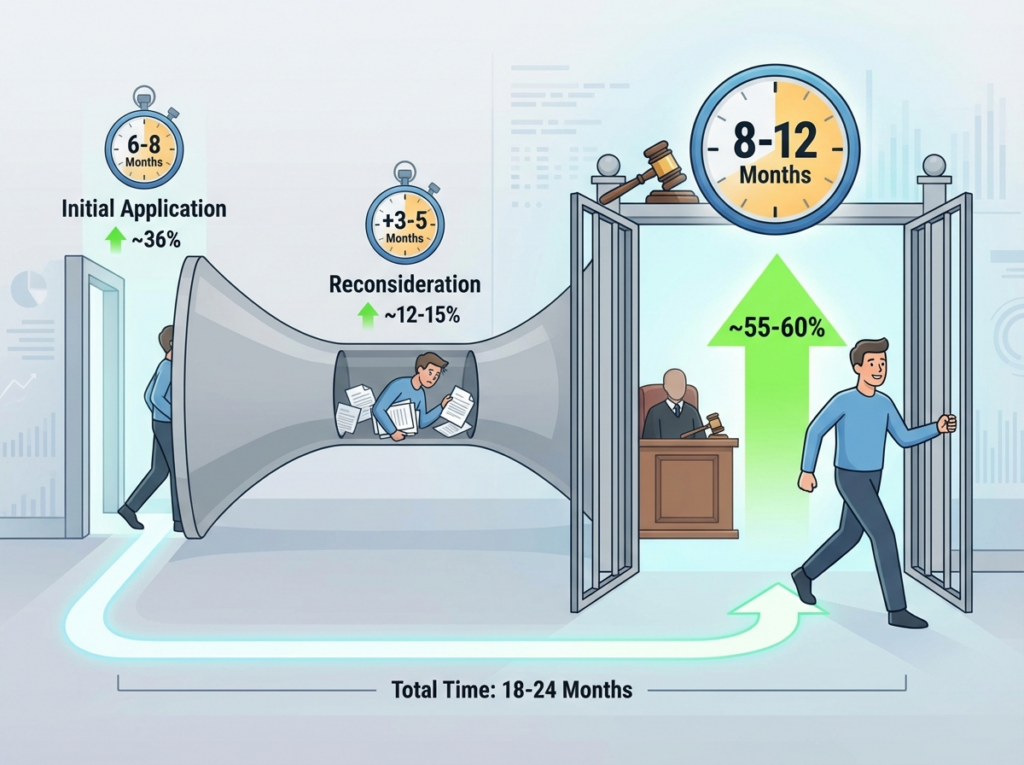
Your approval odds depend heavily on which stage of the process you’ve reached. Most applicants face denial at the initial application, regardless of age or condition severity.
- Initial Application: ~36% approval rate, 6-8 month wait
- Reconsideration: ~12-15% approval rate, additional 3-5 months
- ALJ Hearing: ~55-60% approval rate, 8-12 months
The hearing stage is where age truly shines. Administrative Law Judges have discretion to apply Grid Rules and consider your testimony directly. The total time from initial application to hearing decision averages 18-24 months nationally, with significant variation by location—Houston processes faster than New York City.
| Application Stage | Approval Rate | Average Wait Time (2026) | Notes |
|---|---|---|---|
| Initial Application | Approximately 36% | 6–8 months | Most applicants denied unless condition qualifies under Compassionate Allowances listings |
| Reconsideration | 12%–15% | 3–5 months additional | Low overturn rate; often characterized as procedural step before hearing |
| ALJ Hearing | 55%–60% | 8–12 months | Judges apply Grid Rules with discretion; total time from initial application to hearing decision averages 18–24 months nationally |
Example Scenario
Robert, age 52, worked as an electrician for 25 years before chronic back problems and nerve damage made it impossible to continue. His doctor assessed him with an RFC limiting him to sedentary work only, meaning he cannot stand or walk for extended periods.
At 52, Robert falls into the “Closely Approaching Advanced Age” category under SSA’s Grid Rules. Since he cannot return to his physically demanding past work and has no transferable skills to sedentary occupations, the Grid Rules work in his favor.
After an initial denial and reconsideration rejection, Robert’s case was approved at the ALJ hearing level. The judge applied the Grid Rules, finding that a 52-year-old limited to sedentary work with no relevant desk experience should not be expected to transition to an entirely new career field.
Frequently Asked Questions
How does age affect SSDI approval rates?
Age is the single most significant non-medical factor in SSDI claims. Approval rates jump from 30-40% for those under 50 to 45-50% at ages 50-54, and reach 60-65% for applicants aged 60-64. This is because the Grid Rules presume older workers have diminished ability to retrain for new careers.
What are the SSDI Grid Rules?
The Grid Rules (Medical-Vocational Guidelines) are SSA regulations that factor in age, education, work history, and physical capacity. At age 50, if you’re limited to sedentary work and can’t do your past job, approval is often mandated. At 55, this protection expands to light work limitations, making approval even more likely.
What is the SSDI approval rate at the hearing level?
The approval rate at the ALJ (Administrative Law Judge) hearing level is approximately 55-60%. This is significantly higher than the initial application approval rate of 36% or the reconsideration approval rate of 12-15%. Most successful SSDI claims are won at the hearing stage, not the initial application.
How long does the SSDI application process take in 2026?
The total time from initial application to hearing decision averages 18-24 months nationally. Initial applications take 6-8 months, reconsideration adds 3-5 months, and waiting for an ALJ hearing takes another 8-12 months depending on your local office.
Can I work while applying for SSDI?
You cannot earn more than the Substantial Gainful Activity (SGA) limit while applying for SSDI. In 2026, the SGA limit is $1,690 per month for non-blind applicants and $2,830 per month for blind applicants. Earning above these thresholds disqualifies you from being considered disabled.
What is past relevant work for SSDI in 2026?
As of 2026, the SSA only examines your work history from the past 5 years (reduced from the previous 15-year lookback). This change benefits older workers significantly—if you performed physically demanding work more than 5 years ago, it no longer counts against your claim.
Why is SSDI harder to get approved for under age 50?
Applicants under 50 must prove they cannot perform any job in the U.S. economy, including sedentary sit-down work. The SSA presumes younger individuals can retrain for easier jobs. After age 50, you generally only need to prove you can’t do your past work, thanks to the Grid Rules.
What This Means for Your Claim
If you’re approaching age 50 or 55, timing your application strategically may improve your odds. The Grid Rules provide a powerful statistical advantage once you cross these thresholds. For younger applicants, expect a longer road.
If you need help gathering evidence or filing your claim, reach out to us at Benefits.com! We want you to have the best shot you can at being approved.
 Benefits.com Advisors
With expertise spanning local, state, and federal benefit programs, our team is dedicated to guiding individuals towards the perfect program tailored to their unique circumstances.
Rise to the top with Peak Benefits!
Join our Peak Benefits Newsletter for the latest news, resources, and offers on all things government benefits.