














What Are SSDI Retroactive Benefits?
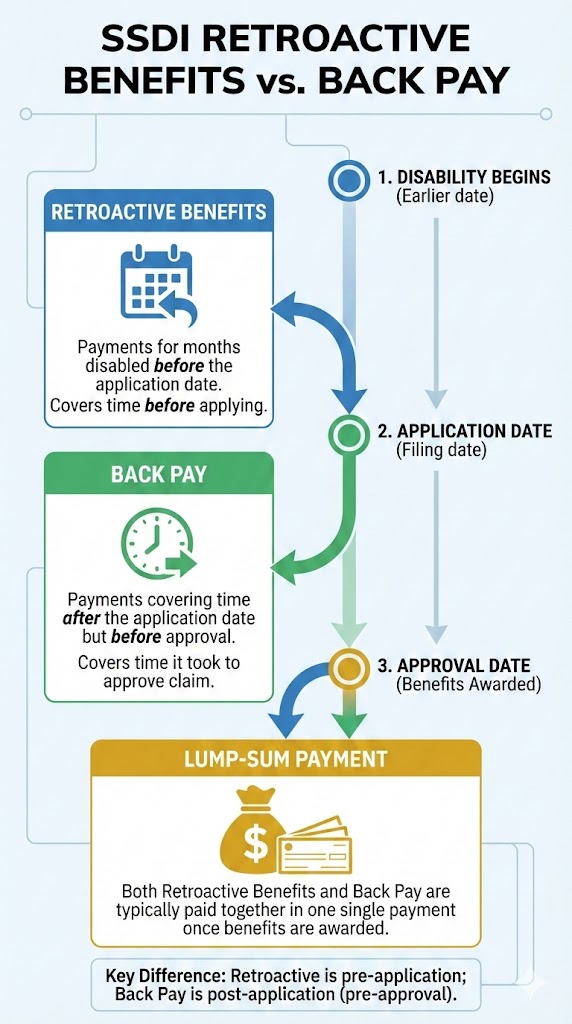
Retroactive benefits are payments issued for the months when a claimant was disabled but had not yet applied for Social Security disability benefits.
Retroactive benefits are often confused with back pay, which refers to the payments covering the time it took Social Security to approve the claim, but the two are slightly different.
- Retroactive SSDI pay covers time before the application date.
- SSDI back pay covers time after the application date but before approval.
Both are typically paid together in a SSDI lump-sum payment once benefits are awarded.
The Role of Disability Onset in SSDI Retroactive Pay
Alleged Onset Date vs. Established Onset Date
The starting point for determining benefits is the disability onset date.
- Alleged Onset Date (AOD): The date the claimant says their disability began.
- Established Onset Date (EOD): The date the Social Security Administration (SSA) officially agrees the disability began.
The EOD Social Security uses is critical. Even if a claimant alleges disability began earlier, SSA may set a later EOD based on medical evidence, work history, or other factors.
Benefits are calculated based on the EOD, not the AOD.
The SSDI Waiting Period Explained
One of the most important SSDI back pay rules is the mandatory SSDI waiting period.
What Is the SSDI Waiting Period?
Federal law requires a five-month waiting period after the established onset date before SSDI benefits can begin. No benefits are paid during these first five full months of disability.
Example:
- Established onset date: January 10
- Waiting period months: February–June
- First payable month: July
This waiting period applies even if the claim is ultimately approved.
How Far Back Does SSDI Pay Retroactive Benefits?
A key question many claimants ask is how far back SSDI pays.
Maximum Retroactive Period
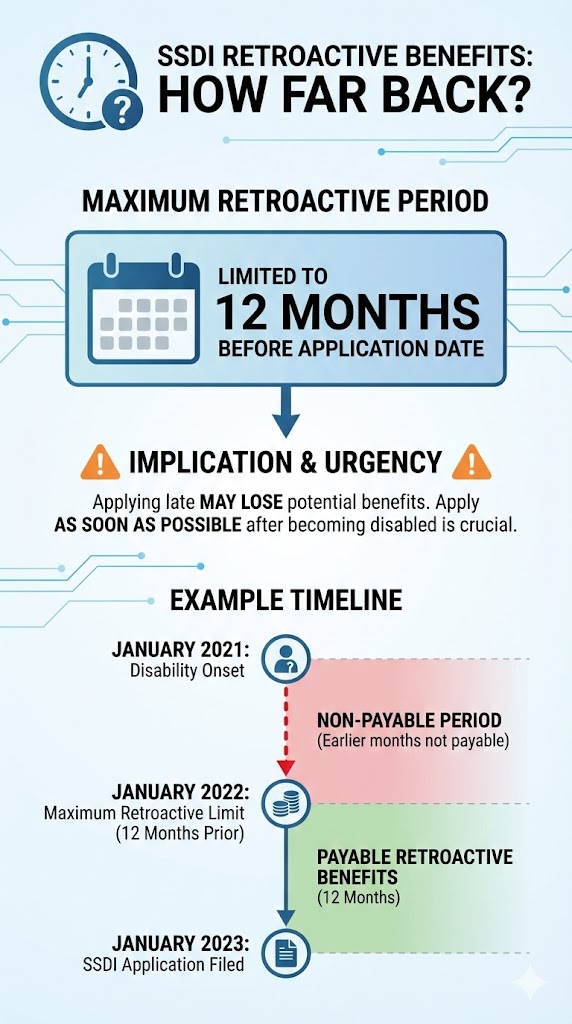
SSDI retroactive pay is limited to 12 months before the application date, even if the disability began earlier.
This means:
- If you apply late, you may lose months of potential benefits.
- Applying as soon as possible after becoming disabled is crucial.
Example:
- Disability onset: January 2021
- SSDI application filed: January 2023
- Maximum retroactive benefits: January 2022 (12 months prior to application)
Earlier months may be medically relevant but are not payable.
SSDI Retroactive Payments vs Back Pay Benefits
| Type of Pay | Time Period Covered |
|---|---|
| SSDI Retroactive Pay | Up to 12 months before application date |
| SSDI Back Pay | From application date to approval date |
Both types are usually paid together once the claim is approved.
Lump-Sum Payment
In most cases, SSDI retroactive and back pay are issued in one lump-sum payment, deposited directly into the claimant’s bank account or mailed as a check.
How SSDI Calculates the Lump-Sum Payment
- Establish the official onset date (EOD)
- Apply the five-month SSDI waiting period
- Identify the first month payable
- Count payable months before application (retroactive)
- Count payable months after application (back pay)
- Multiply months by the monthly benefit amount
- Issue payment as a SSDI lump-sum payment
This SSDI lump-sum payment may arrive:
- Before monthly benefits begin, or
- Shortly after the first monthly payment
Installments (Rare but Possible)
In limited situations—such as when benefits are extremely large or when a representative payee is involved—SSA may divide the payment into installments.
Common Issues That Affect SSDI Retroactive Benefits
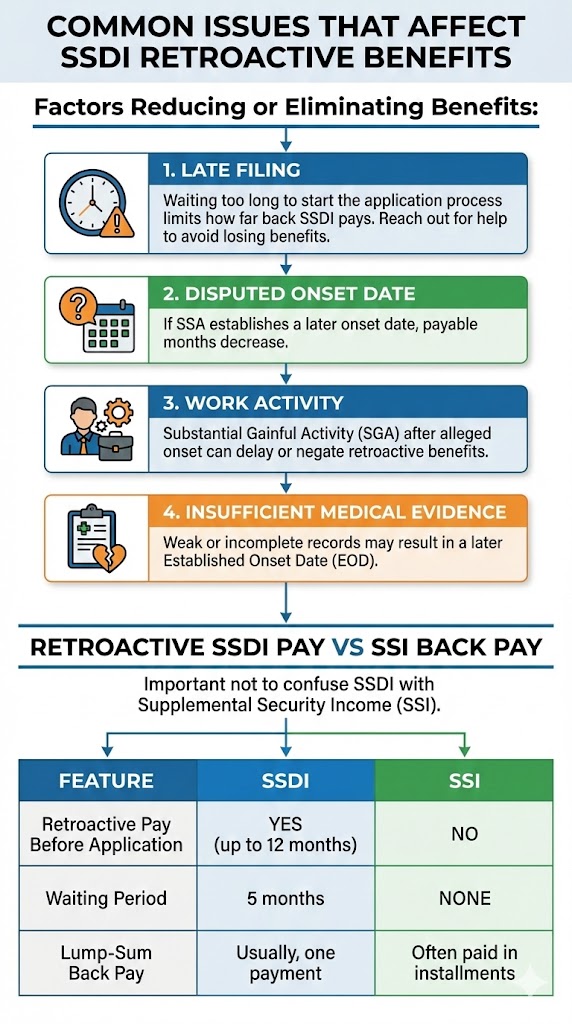
Several factors can reduce or eliminate retroactive Social Security disability benefits:
1. Late Filing
Waiting too long to start the application process limits how far back SSDI pays. Reach out to us now to get help if you don’t know where to start!
2. Disputed Onset Date
If SSA establishes a later onset date, payable months decrease.
3. Work Activity
Substantial Gainful Activity (SGA) after the alleged onset can delay or negate retroactive benefits.
4. Insufficient Medical Evidence
Weak or incomplete records may result in a later EOD.
Retroactive SSDI Pay vs SSI Back Pay
It is important not to confuse SSDI with Supplemental Security Income (SSI).
| Feature | SSDI | SSI |
|---|---|---|
| Retroactive Pay Before Application | Yes (up to 12 months) | No |
| Waiting Period | 5 months | None |
| Lump-Sum Back Pay | Usually, one payment | Often paid in installments |
 Benefits.com Advisors
With expertise spanning local, state, and federal benefit programs, our team is dedicated to guiding individuals towards the perfect program tailored to their unique circumstances.
Rise to the top with Peak Benefits!
Join our Peak Benefits Newsletter for the latest news, resources, and offers on all things government benefits.