















Accessing veterans disability benefits often proves difficult and time-consuming. Even if the process of submitting a claim for benefits can happen relatively quickly, waiting for a verdict can take months.
In the meantime, you’ll likely be expected to handle all of the financial and logistical concerns yourself. Which, if you’re filing for assistance in the first place, is probably something you’re not exactly at liberty to do.
So that begs the question: is there any way to speed this process along?
Is There a Fast Track SSDI for Veterans?
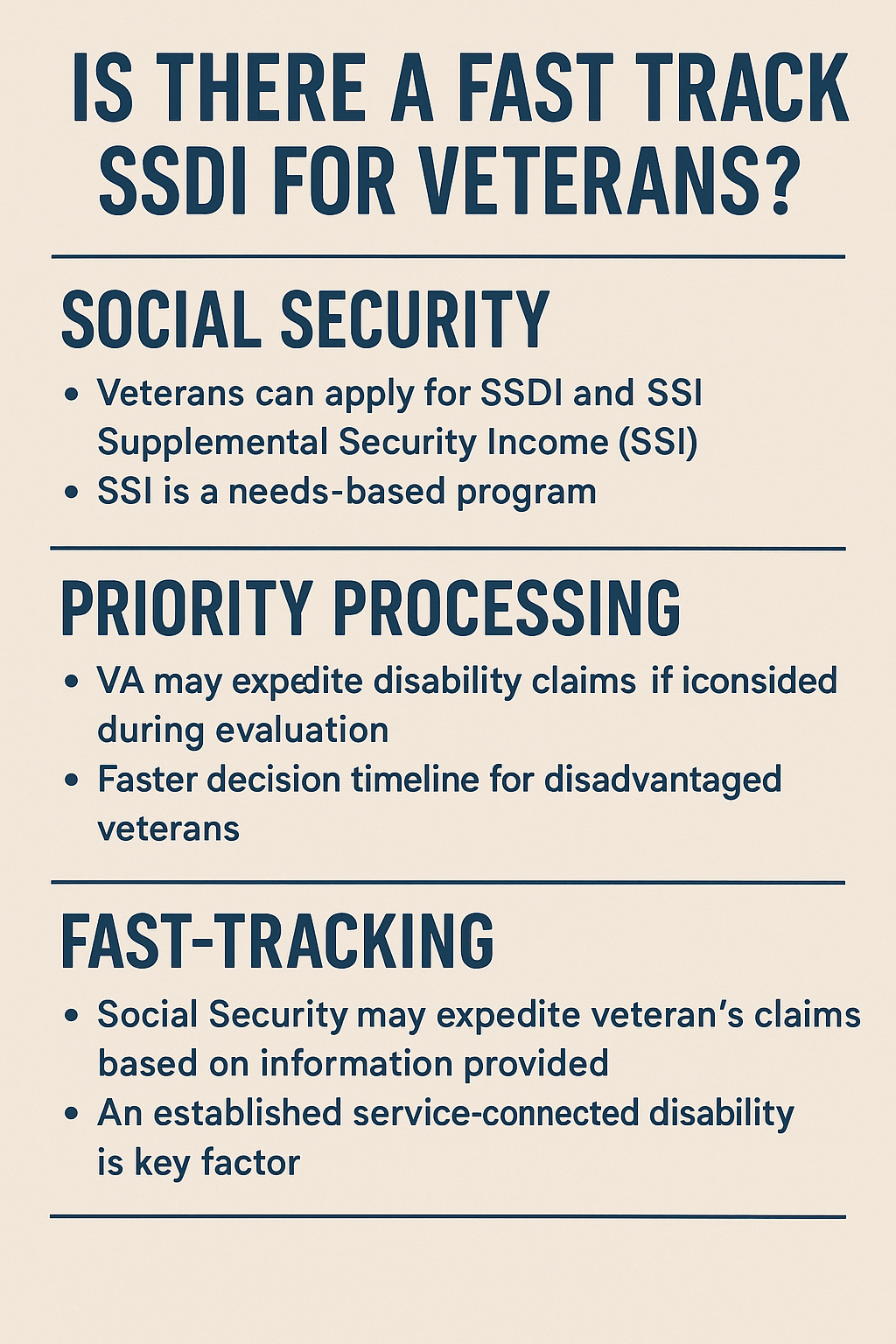
There are two ways to interpret a question like this, because there are two separate places that a veteran can file claims for disability: Social Security, and the VA. Veterans may apply for two programs—Social Security Disability Insurance (SSDI) and Supplemental Security Income (SSI). SSDI is based on your work history and contributions to Social Security, while SSI is a needs-based program for those with limited income and resources.
In the case of the VA, they refer to this as “a request for priority processing of a disability claim,” but you may see terms like “fast track,” “expediting,” and other words that make it sound like a USPS package rather than a request for financial aid. The Department of Veterans Affairs (VA) and the Department of Defense (DoD) often collaborate to share medical records and expedite claims processing for veterans. You may also see this all referred to generally as Social Security Disability Insurance (or SSDI).
(You probably know some of this already, but not everyone does, and sometimes it’s helpful to put all the related words in one place—both so you know what else you can look for, and so the search engines can point you to the right answer no matter what words you used.)
The priority request process is a way to speed up the review and decision timeline for your claim. It’s intended for use by individuals who are dealing with an elevated level of disadvantage, endured some of the most difficult experiences a tour of duty has to offer, or who find themselves at the wrong end of intense financial struggles. The nature of your medical condition is carefully considered during the evaluation to determine if expedited processing is warranted. For example, a veteran with a service connected diagnosis of PTSD under listing 12.15 may be expedited due to the severity and direct link to their military service.
You should be aware that there’s not an officially stated timeline estimate for expedited claims, just that it should be faster than the average seven to nine months for standard reviews.
For Social Security, the process is a little different. You file a claim as normal, and certain qualifiers are automatically flagged for fast-tracking (though they still advise you to reach out and make your qualification explicit). The SSA determines eligibility for fast-tracking based on the information you provide, including whether your disability is service connected and if you are recognized as a wounded warrior.
Notably, where qualification for priority processing also meets the qualification for disability with the VA, the same is not necessarily true in the other direction. Social Security may not approve your claim, even if it was marked as eligible for fast-tracking. Military service and the presence of a service connected disability are key factors in determining eligibility for expedited Social Security processing.
Who Qualifies for Expedited Processing?
According to the VA, in order to qualify for priority processing, you have to meet at least one of the following descriptions:
- Former POW
- Age 85 or older
- Diagnosed with a terminal illness
- Diagnosed with ALS/Lou Gehrig’s disease
- Received Medal of Honor or Purple Heart
- Received Very Seriously Injured or Ill (VSI) or Seriously Injured or Ill (SI) status from the DOD
- Experiencing extreme financial hardship (job loss, dramatic decrease in income, etc.)
- Unhoused, or at risk of becoming unhoused
For Social Security claims, you have qualifiers tied specifically to veterans:
- Wounded Warrior status (served on or after October 1, 2001, and became disabled while active duty)
- 100% P&T from the VA
To qualify for certain expedited processing, a veteran must be determined to be 100% service-connected for disabilities by the VA. Disabilities resulting from service-related injuries are considered when evaluating eligibility. Medical evidence from doctors, including both VA and private physicians, is crucial in supporting your claim for expedited processing.
You also have the standard methods of qualifying for faster processing that are also available to civilians:
- Terminal Illness (TERI)
- Dire need
- Congressional inquiry
- Compassionate Allowance
What matters most is the presence of a qualifying disability, not factors like employment history or other unrelated qualifications.
How to Apply for Fast-Track SSDI Benefits
As mentioned above, applying for faster review with the SSDI isn’t a separate process; the review teams will flag it on their end if it qualifies. However, it is crucial to ensure you are submitting all required evidence and documentation when applying, as this can help avoid delays. You should still follow up and make it clear, though, per their own recommendation. Scheduling an appointment with the SSA can also help ensure your claim is processed in a timely manner. As part of the evaluation process, you may be required to attend a medical exam conducted by an SSA doctor. The SSA will consider medical opinions from your doctor as well as from their own consultative examiner when making a decision on your claim.
For VA benefits, you’ll have to submit a separate application requesting that your claim application receive priority processing. That might feel a bit like filing paperwork that asks them to look at the other paperwork you filed, but it’s still a tool available to vets that can help move the needle faster.
Tips to Speed Up Your SSDI Application

Aside from seeking expedited processing, your options for kicking things into high gear are a bit limited. But you’re not wholly without levers to pull.
Obtaining thorough medical evidence from your doctors is crucial, as their medical opinion can significantly influence the speed and outcome of your claim. Submitting detailed records from both VA and private doctors can help ensure the SSA has all the information needed. The SSA may require a medical exam to gather additional evidence about your physical or mental condition, and they consider both physical and mental conditions as part of the medical evidence. The SSA may rely on medical records and opinions from both VA and private doctors when making a decision. Various factors can speed up or slow down your claim, such as the completeness of your medical evidence, the need for additional medical exams, and how quickly you respond to requests for information.
Once things are submitted it’s just a matter of consistently following up. You’re likely to get annoyed doing it, and the people on the other side of the phone might feel a bit annoyed having you call in again, but checking in on at least a weekly basis is a broadly established best practice for these processes.
Can You Receive VA Disability Benefits and Social Security Disability Benefits at the Same Time?
Finally, we’ll answer the question that is tangled up in all of this: can you receive benefits from both agencies simultaneously?
The short answer is “yes.” The slightly longer answer is “yes, but…” as in some circumstances, receiving SSDI benefits can affect your eligibility for VA benefits, and the amount of money you receive from VA benefits can also affect your eligibility for SSDI and SSI. Receiving veterans disability benefits and social security benefits at the same time is possible, but one can affect the other, especially when it comes to income limits and eligibility rules.
All of the specifics here get pretty nuanced (as they often do). For example, VA disability compensation is considered unearned income, which can impact SSI eligibility and benefit amounts. Additionally, taxes may apply differently to SSDI and VA benefits, and understanding how unearned income and taxes interact is important for planning. If your claim is approved by both the SSA and Veterans Affairs, you may be eligible for both types of benefits. Veterans Affairs determines your disability rating, which can also influence the processing of your social security benefits claim.
Attorneys who assist with claims may be paid from the back pay awarded to the claimant. Back pay refers to the total amount of benefits owed to you from the date you became disabled to the date your claim is approved, and it is calculated based on the time between your established onset date and your approval date for SSDI or SSI.
There’s not much reason to only apply for one. And if you’ve already collected the evidence for one application, it’s a lot easier to add it to the second one for the other agency.
None of this is a guarantee, and timeline projections are hard to come by once you’ve submitted, but if you qualify, you’re entitled to those benefits. So don’t be shy about trying to get the process moving a little faster.
Where Disabled Veterans Can Get Help with Their SSDI Application
Navigating the Social Security Disability Insurance (SSDI) application process can be challenging, especially for veterans who are already managing VA disability benefits or complex medical conditions. Fortunately, there are several resources available to help veterans successfully file their disability claims and secure the benefits they deserve.
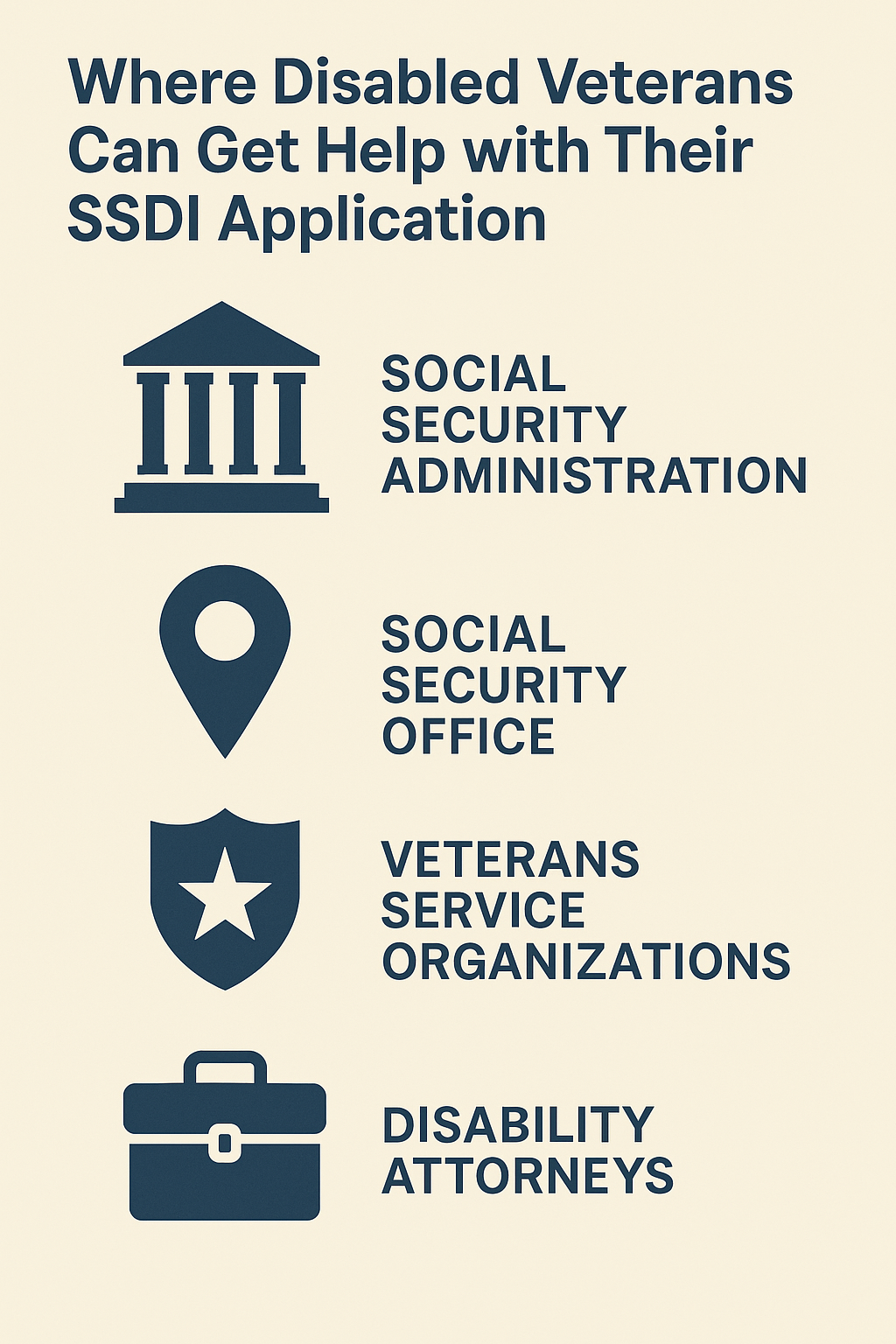
The Social Security Administration (SSA) provides a wealth of information on their website, including step-by-step guidance on the application process and what medical evidence is required. Veterans can also visit their local Social Security office to speak directly with a Social Security representative, who can answer questions, clarify the rules, and offer personalized support throughout the process.
For more specialized assistance, Veterans Service Organizations (VSOs) and disability attorneys are invaluable allies. These professionals are experienced in handling both VA disability benefits and Social Security disability benefits, and they understand the unique challenges disabled veterans face. Whether you’re filing for SSDI, SSI benefits, or both, VSOs and attorneys can help you gather the necessary medical records, prepare your documents, and submit a strong disability claim. Their expertise ensures that your application is complete and that all relevant medical conditions and medical opinions are included, which is crucial for expedited processing.
Veterans who are rated 100% disabled according to VA rates should make sure to identify this status when applying for SSDI. This can qualify you for expedited processing, significantly reducing the time it takes to receive a decision on your claim. To take full advantage of this, submit all required evidence and documentation promptly, including detailed medical records and any supporting statements from your healthcare providers.
In addition to these resources, law firms like Cannon Disability Law offer free consultations to veterans seeking help with their SSDI or SSI claims. These legal professionals are well-versed in the application process and can provide guidance on how to navigate the system, ensuring that your claim is handled efficiently and that you receive the disability benefits you are eligible for.
By utilizing these resources and understanding the process, veterans can confidently move forward with their SSDI application. Don’t hesitate to contact the SSA, reach out to a VSO, or consult with a disability attorney to get the support you need. Disabled veterans have the right to expedited processing and should take every step necessary to ensure their claim is processed quickly and accurately.
At Benefits.com, we are here to help you navigate the process and receive the benefits you deserve. Begin today by taking our free eligibility quiz.
 Benefits.com Advisors
With expertise spanning local, state, and federal benefit programs, our team is dedicated to guiding individuals towards the perfect program tailored to their unique circumstances.
Rise to the top with Peak Benefits!
Join our Peak Benefits Newsletter for the latest news, resources, and offers on all things government benefits.