














Social Security back pay refers to the retroactive benefit payments you may receive when your Social Security Disability Insurance (SSDI) or Supplemental Security Income (SSI) application is approved. This compensation covers the period between your disability onset or application date and the approval date, accounting for the lengthy processing times.
SSDI back pay includes a five-month waiting period and can be retroactive up to 12 months before your application date, while SSI back pay starts from the first full month after your application. The calculation varies significantly between the two programs and can become complex, especially for concurrent claims where SSDI payments might offset SSI amounts.
Why This Update

Social Security benefits are updated each year with the COLA, which can affect back pay rates if you are owed money from 2026.
Social Security Back Pay
Social Security back pay provides retroactive disability benefits for people applying for Social Security Disability benefits for SSDI and SSI. It covers the period from your established disability onset or application date until your claim is approved. The purpose is to compensate for the often lengthy processing times of disability applications.
SSDI Back Pay
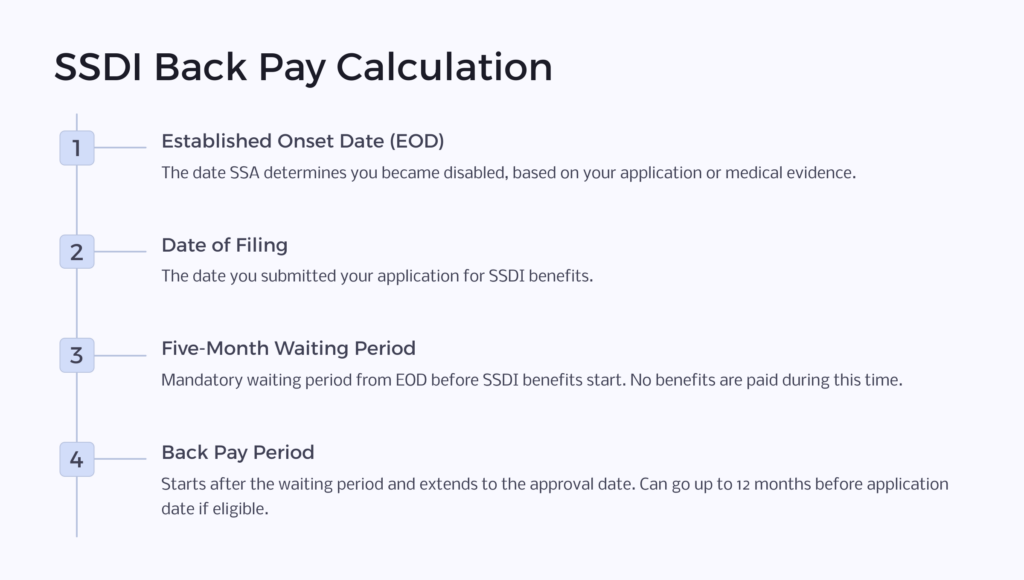
SSDI back pay calculation is based on your Established Onset Date (EOD) and the date you filed your application. The EOD is the date the Social Security Administration (SSA) determines when your disability began based on medical evidence. This date is crucial for calculating SSDI back pay, as the five-month waiting period starts from the EOD.
A mandatory five-month waiting period applies from your EOD before benefits begin to accrue. You will not receive benefits during this period. The back pay period runs from the end of the five-month waiting period up to your claim approval date.
Your monthly benefit amount, which determines the total back pay, is based on your average lifetime earnings. This amount remains consistent throughout the back pay calculation period. The longer the processing time after your waiting period ends, the larger your potential back pay amount.
SSI Back Pay
SSI back pay begins from the first full month after your application date or the date you became eligible, whichever is later. Unlike SSDI, there is no five-month waiting period for SSI benefits. This difference may significantly affect when your payments start and how much back pay you receive.
The monthly benefit amount is needs-based, considering your income and living situation, up to the maximum federal benefit rate. Large SSI back pay amounts exceeding three times the maximum monthly benefit are typically paid in three installments. This installment approach may help protect your eligibility for other means-tested benefits by preventing a large lump sum from counting as a resource all at once.
State supplementary payments and any interim assistance received from the state can affect the total SSI back pay amount. If you received state assistance while waiting for your SSI decision, the state may be reimbursed from your back pay.
Concurrent Claims: SSDI and SSI Back Pay Together
Concurrent claims involve potential eligibility for both SSDI and SSI benefits, which may lead to complex back pay coordination. When you qualify for both programs, the calculations become interconnected in ways that may be difficult to predict.
SSDI back pay can reduce or offset your SSI back pay because SSDI counts as income for the needs-based SSI program. For people who qualify for both programs, the SSDI retroactive payment is generally computed first and then considered as income for the SSI retroactive payment. Any interim SSI payments received while waiting for SSDI approval may be recouped from your SSDI back pay if they later become an overpayment.
Despite coordinated processing, SSI and SSDI back pay are issued as separate payments. You will receive distinct notifications and payments for each program, even though they were processed together.
Example Scenario
If you applied for SSDI benefits last year and your claim was recently approved after a lengthy review, you might be anticipating back pay.
One veteran discovered that their approved Established Onset Date (EOD) was several months before their application, potentially qualifying them for retroactive benefits in addition to payments covering the processing period, after the initial waiting period.
Legal representation can help ensure you receive every dollar you’re entitled to in back pay. Disability attorneys typically work on a contingency fee basis, meaning you only pay a fee if you win your case, and this fee is usually deducted from your back pay according to SSA guidelines.
Frequently Asked Questions
What is the difference between SSDI and SSI back pay?
SSDI back pay is calculated based on your work history and the established onset date of your disability, including a five-month waiting period and possible retroactive payments up to 12 months before your application date. SSI back pay is calculated based on financial need and your application date, beginning from the first full month after you apply, with no waiting period.
Is there a waiting period for Social Security disability back pay?
Yes, for SSDI, there is a mandatory five-month waiting period from your Established Onset Date (EOD) during which no benefits are paid. There is no such waiting period for SSI back pay.
How far back can SSDI back pay go?
SSDI back pay can be retroactive up to 12 months before the date you filed your application, provided the Social Security Administration determines you were disabled during that period.
How is SSI back pay typically issued?
If your SSI back pay amount is significant (exceeding three times the maximum monthly benefit), it is usually paid in three installments. Smaller amounts may be paid in a single lump sum.
Can receiving SSDI back pay affect my SSI benefits?
Yes, if you qualify for both SSDI and SSI (a concurrent claim), your SSDI back pay can count as income for SSI purposes, potentially reducing the amount of SSI back pay you receive.
SSI recipients should be aware that receiving SSDI back pay may affect their resource limits and eligibility for SSI.
What is an Established Onset Date (EOD)?
The Established Onset Date (EOD) is the disability onset date as determined by the SSA. This date is crucial for calculating SSDI back pay, as the five-month waiting period starts from the EOD.
Should I get a lawyer to help with my back pay calculation?
While not always necessary, consulting a Social Security disability lawyer or advocate can be highly beneficial, especially for complex cases, concurrent claims, or if you believe your back pay calculation is incorrect. Attorney fees are typically deducted from your back pay according to a fee agreement, and the SSA caps attorney fees at 25% of your back pay or $9,200, whichever is less.
Maximizing Your Back Pay and Managing Funds
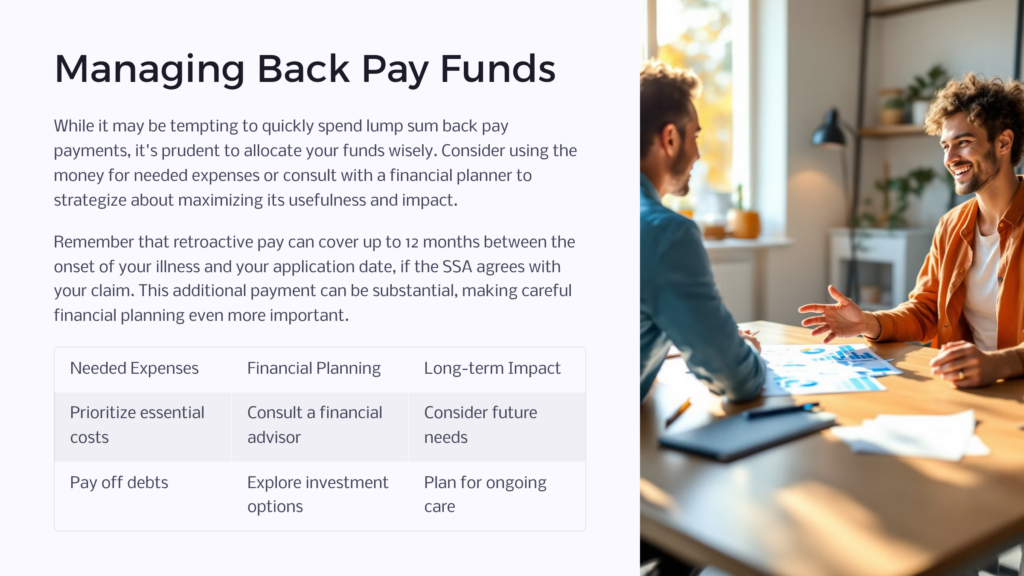
Apply for Social Security Disability benefits as soon as your disability begins to maximize your potential back pay. Delaying your application reduces the retroactive period for SSDI, which is limited to 12 months before your application date. For SSI, benefits cannot begin before the first full month after you apply.
Keep in mind that receiving a lump-sum back payment might affect eligibility for other means-tested benefits like Medicaid or housing assistance. Back pay impacts your resources and may temporarily reduce or eliminate your monthly SSI payment during the exclusion period.
While retroactive SSI and SSDI payments are excluded from resources for nine months, they become countable after that period. Plan carefully for how you will use your back pay to cover past expenses and secure future financial stability. It’s important to consider how your back pay and the timing of payments may affect your future benefits and ongoing monthly disbursements.
If you still have questions about your back pay or whether or not you will receive the right benefits, reach out to us at Benefits.com! We are here to help!
 Benefits.com Advisors
With expertise spanning local, state, and federal benefit programs, our team is dedicated to guiding individuals towards the perfect program tailored to their unique circumstances.
Rise to the top with Peak Benefits!
Join our Peak Benefits Newsletter for the latest news, resources, and offers on all things government benefits.