













Thanks to the Americans with Disabilities Act, Michigan residents with disabilities have a number of resources to receive financial assistance, including federal and state programs. At the federal level, the Social Security Administration (SSA) oversees Social Security Disability Insurance (SSDI) and Supplemental Security Income (SSI) benefits.
Michigan is home to a dedicated network of organizations that advocate for the disability community and promote inclusion, diversity, and equity. Disability Rights Michigan (DRM) is the state’s designated protection and advocacy system, offering free legal advocacy and support to empower individuals with disabilities and advance disability rights. Centers for Independent Living (CILs) and Disability Network Southwest Michigan (DNSWM) serve the community by providing advocacy, support, and a range of services designed to enhance quality of life, promote inclusion, and empower individuals with disabilities to achieve their full potential.
These disability services are run through Michigan Disability Determination Services (DDS) which processes all SSA disability claims and determines what benefits are awarded.
Michigan disability services also extend to state programs like their State Disability Assistance (SDA), unemployment benefits, workers’ compensation, and Medicaid (a joint federal and state program). Michigan currently does not provide state short-term disability benefits, but you may qualify for coverage through private insurance companies or your employer.
Author’s Take
As someone who works closely with disability claimants, I’ve seen firsthand how confusing and frustrating the process can be for Michigan residents. Many people assume that if they have a serious medical condition, benefits will come easily—but the reality is that a large percentage of initial claims are denied.
That’s why it’s so important to understand the rules, keep up with medical treatment, and know that a denial is often just the first step. With the right information and guidance, many applicants who are turned down at first are eventually able to secure the benefits they deserve.
Michigan Statistics
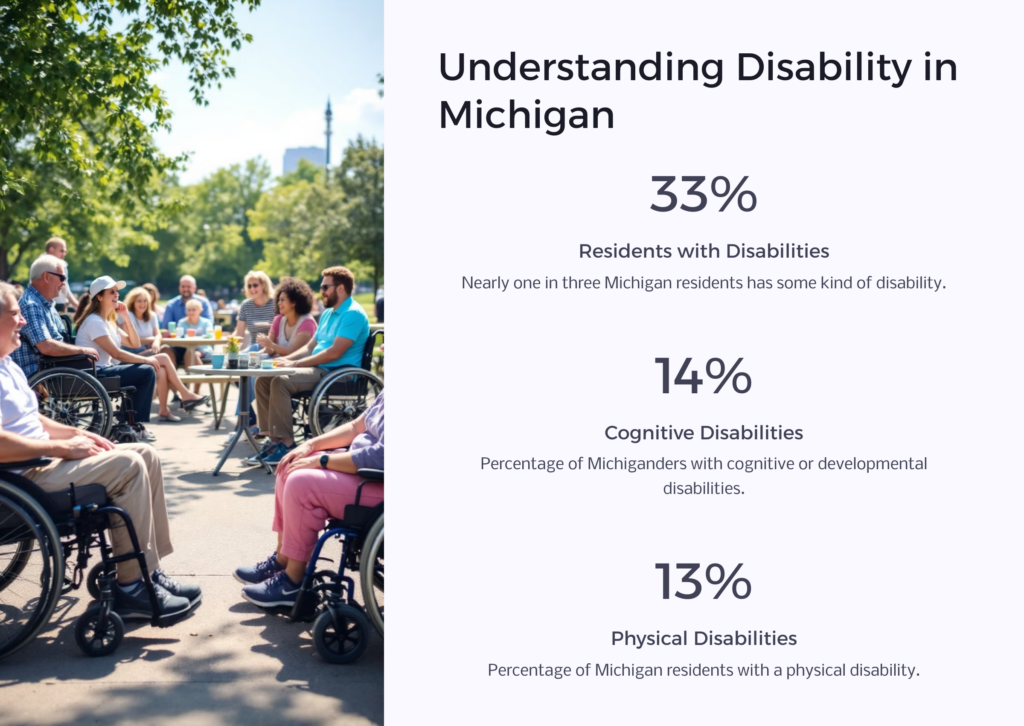
Nearly one in three Michigan residents has some kind of disability. 14% of Michiganders have cognitive or developmental disabilities, and 13% have a physical disability. Disabilities can significantly impact the quality of life, affecting accessibility to health services, community resources, and overall wellbeing.
Only 4.8% of residents currently receive Social Security disability benefits, leaving a large portion of the disabled population without financial assistance.
How To Qualify for Social Security Disability Insurance in Michigan
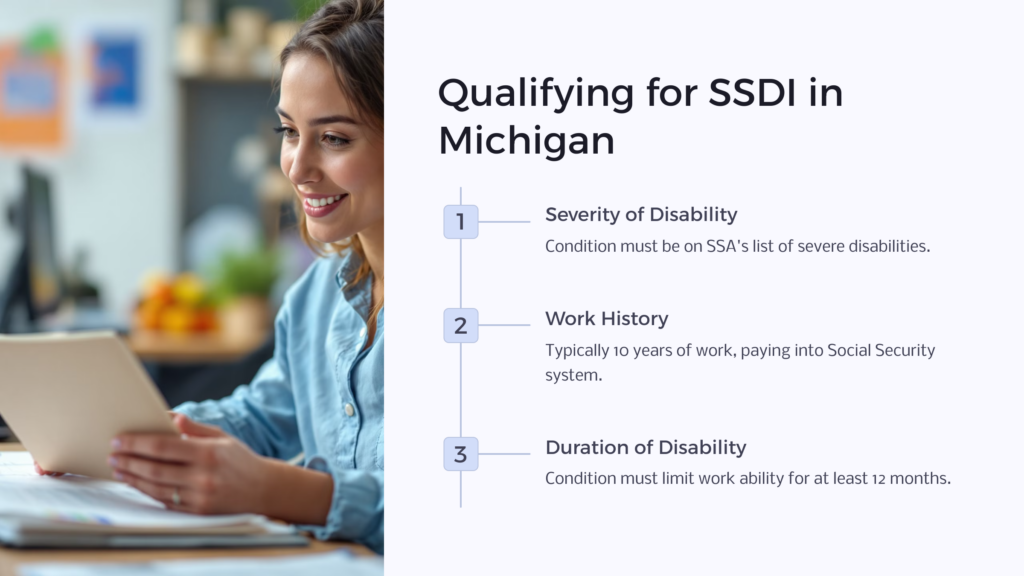
The criteria for receiving Social Security Disability are the same in all states since it is a federally funded program. To be eligible for SSDI, you must be unable to work due to a medical condition that is expected to last at least one year or result in death. The two main criteria to meet are connected to the severity of your documented disability and whether you’ve worked long enough to pay into the Social Security system.
The SSA has compiled a comprehensive list of disabilities that it considers “severe” enough to earn disability insurance. Please consult this list before submitting your disability claim to ensure your condition is on it. Your condition must limit your ability to work for at least 12 months to qualify. To qualify for Social Security Disability Insurance (SSDI), you must have a disability that lasts longer than one year and meet work credit requirements based on your age.
You will also have to show an adequate work history, meaning you have paid enough in taxes to qualify to receive assistance. The minimum amount of time that an individual must work is typically 10 years. Note that this can vary depending on your age and disability.
If you are found eligible for SSDI, you may become eligible for Medicare benefits after a waiting period. Those who qualify for SSI, on the other hand, receive Medicaid benefits immediately.
If you are currently working in some capacity, you are protected under federal law from disability discrimination. Your employer must provide any reasonable accommodation for your medical condition to help you complete your job duties.
Even if you meet SSA requirements, your claim still may be denied. Since determination is made at the state level, it’s up to the Michigan Department of DDS to review your application. In the state of Michigan, roughly 65% of all first-time applications are denied. However, if you receive a denial, you can start the appeals process to pursue your benefits.
How To Apply for SSDI in Michigan
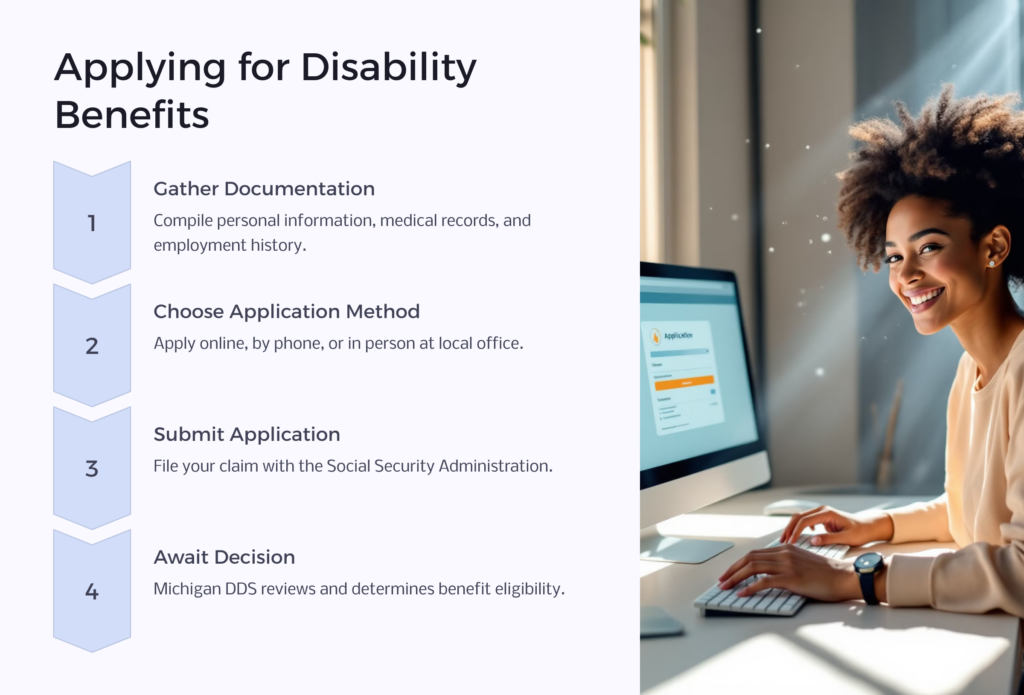
You can apply for SSD benefits in person, over the phone, or online. Applications for SSDI in Michigan are made to your local Social Security field office. Michigan has 45 offices throughout the state.
Applying online at the federal Social Security website is the fastest way for an applicant to submit their claim, or you can also call (800) 772-1213 to speak with a representative who can walk you through the process. If you wish to apply in person, you’ll need to schedule an appointment first.
Before you apply, take the time to compile the appropriate documentation and medical evidence to support your claim. Be sure to complete all required forms and submit them promptly to avoid delays. In general, you should have the following:
- Personal information: Full names and DOBs for you, your spouse, and any minor children. They may also ask for your Social Security number, birth certificate, medical record, or marriage or divorce documentation.
- Medical records associated with your disability. This includes contact information for doctors, clinics, or existing services and should cover any physical, intellectual, or mental illness.
- Past and current employment information
- Proof of income and work history
- Education records, such as transcripts or diplomas, as part of your supporting documents
After submitting your application, follow up with the SSA to check on the status and ensure your request is being processed.
More Michigan Benefits
Supplemental Security Income (SSI)
Supplemental Security Income (SSI) is another Social Security benefit like SSDI. SSI eligibility is based on both earned and unearned income. SSI benefits are intended for those with very low income who are disabled, blind, or over 65 years old. When you apply for SSDI, the DDS will evaluate your application to see if you also qualify for SSI benefits.
Michigan State Disability Assistance (SDA)
Michigan provides State Disability Assistance (SDA) run by the Michigan Department of Health and Human Services (MDHHS). This program provides cash assistance to disabled residents (or in some cases those 65+ without a disability) or to a caretaker of a disabled person.
SDA eligibility is based on having limited income and assets. MDHHS considers both countable income and assets when determining eligibility and the payment amount for SDA. The asset limit is $15,000 for cash, retirement plans, and investments, and $200,000 for real property. Clients must report any changes in household size, income, or assets to MDHHS within 10 days.
To qualify for SDA based on a disability, you must receive disability-related benefits (such as Medicaid due to disability or blindness), live in a Qualified Special Living Arrangement, be diagnosed with AIDS, or be certified as unable to work for at least 90 days due to a disability.
Applicants must be U.S. citizens or qualified legal immigrants and cannot receive cash assistance from any other state. The application process for SDA typically takes around 60 days to complete, and clients will be notified if their application is approved. If you are applying for SDA based on a disability, you must also apply for Social Security disability.
Those seeking SDA benefits can apply online using MI Bridges, or you can get personalized help by contacting your local county office. Beneficiaries will receive aid via a Bridge card which can be used like a debit card to withdraw cash or pay for items like groceries.
If you qualify for SSDI benefits, you automatically qualify for SDA. You can also qualify if you are living in a “qualified Special Living Arrangement facility,” like housing for aged, infirmed, or disabled adults. You can also receive SDA benefits if you’re in an independent living situation receiving help from a caretaker.
Michigan Medicaid
Michigan Medicaid offers health insurance and other health-related services to individuals earning less than $17,131 a year. Most people who qualify for SSI will also qualify for Medicaid. Recipients of Medicaid typically have to pay a very low co-pay for services that average $2 to $3 per service.
Individuals who qualify for Social Security Disability Insurance (SSDI) may become eligible for Medicare after a waiting period, while those on SSI receive Medicaid benefits immediately.
ABLE Accounts allow individuals whose disability began before age 46 to save for disability-related expenses without losing Medicaid or other benefits.
Michigan Unemployment
Those who need temporary financial assistance due to a loss of employment through no fault of their own can apply for Michigan unemployment benefits, managed by the Michigan Department of Labor and Economic Opportunity. This is a weekly cash benefit of up to $362. The fastest and easiest way to submit an unemployment claim is online through the state’s Michigan Web Account Manager (MIWAM).
Example Scenario
Kayleigh, a 45-year-old Michigan resident, was a client seeking disability benefits after working as a nurse for 20 years before a severe back injury prevented her from performing her job duties. After filing for SSDI, her initial claim was denied. The attorney’s support was extremely helpful in gathering additional medical evidence and navigating the appeals process. With this assistance, she won her appeal at the Administrative Law Judge hearing and began receiving federal disability benefits.
Frequently Asked Questions
What is the difference between SSDI and SSI in Michigan?
SSDI (Social Security Disability Insurance) is for those with a work history who have paid Social Security taxes, while SSI (Supplemental Security Income) is a needs-based program for low-income individuals who are disabled, blind, or over 65, regardless of work history.
How long does it take to get disability benefits in Michigan?
The initial application process can take several months. If an appeal is necessary, it can extend the timeline significantly, potentially taking over a year, especially for an Administrative Law Judge hearing.
Can I work while receiving disability benefits in Michigan?
The SSA has specific rules regarding working while receiving benefits, known as ‘trial work periods’ and ‘Substantial Gainful Activity’ (SGA) limits. Earning above the SGA limit may indicate you no longer meet disability criteria.
Where can I apply for Michigan State Disability Assistance (SDA)?
You can apply for Michigan SDA online through MI Bridges, the state’s online portal for benefits, or by contacting your local county office of the Michigan Department of Health and Human Services (MDHHS).
What happens if my disability claim is denied in Michigan?
If your claim is denied, you have 60 days to file an appeal. The appeals process includes reconsideration, a hearing before an Administrative Law Judge, review by the Appeals Council, and finally, federal court review.
Do I need a lawyer for my Michigan disability claim?
While not legally required, hiring a disability attorney is often recommended, especially during the appeals process. An attorney can help gather evidence, present your case effectively, and navigate complex legal procedures.
Does Michigan have a state short-term disability program?
No, Michigan does not have a state-funded short-term disability program. Residents may seek coverage through private insurance companies or employer-provided benefits, if available.
Here at Benefits.com, we want to make sure you understand the resources you have! Reach out to us with any questions you have about your benefits (or potential benefits)!
 Benefits.com Advisors
With expertise spanning local, state, and federal benefit programs, our team is dedicated to guiding individuals towards the perfect program tailored to their unique circumstances.
Rise to the top with Peak Benefits!
Join our Peak Benefits Newsletter for the latest news, resources, and offers on all things government benefits.