













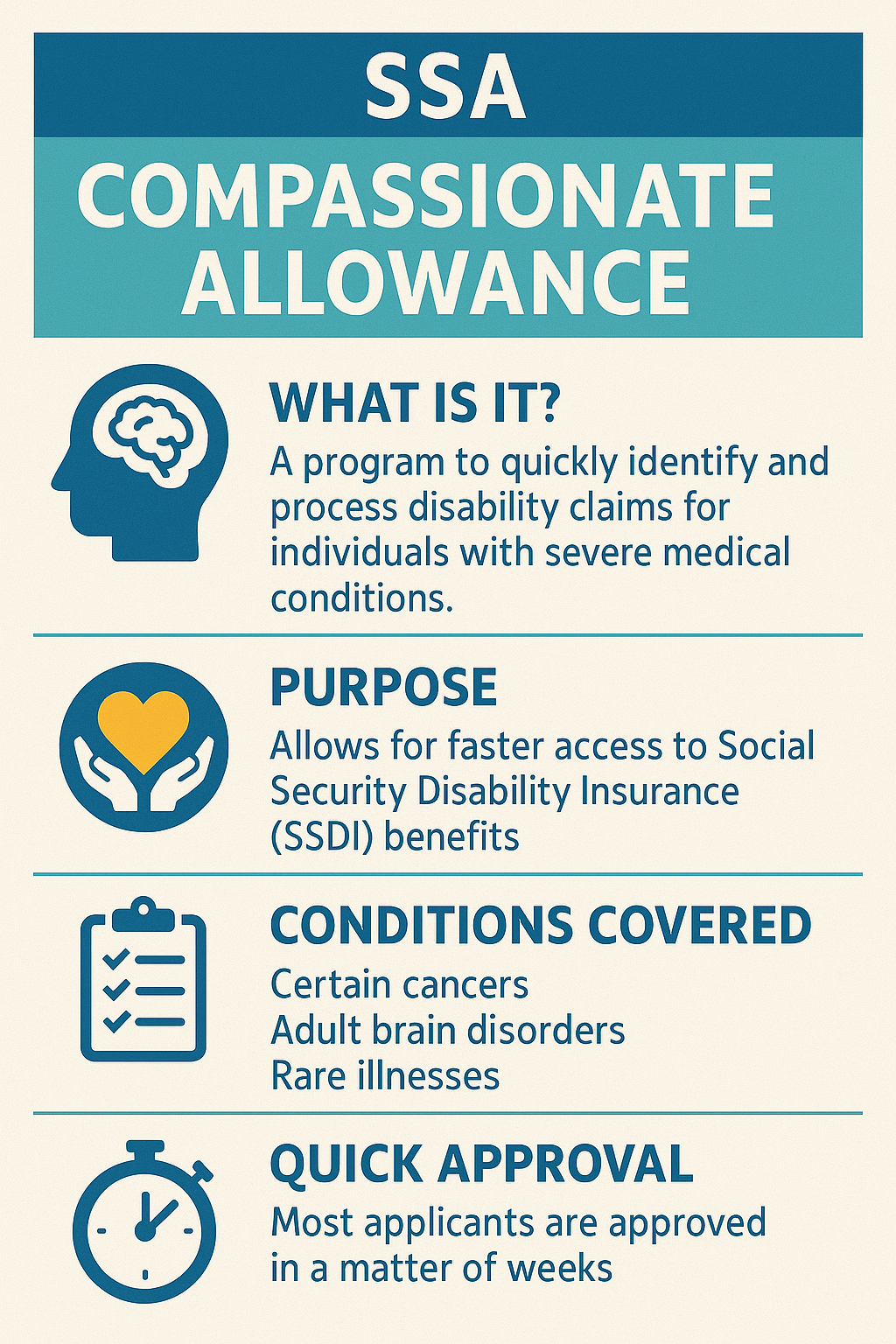
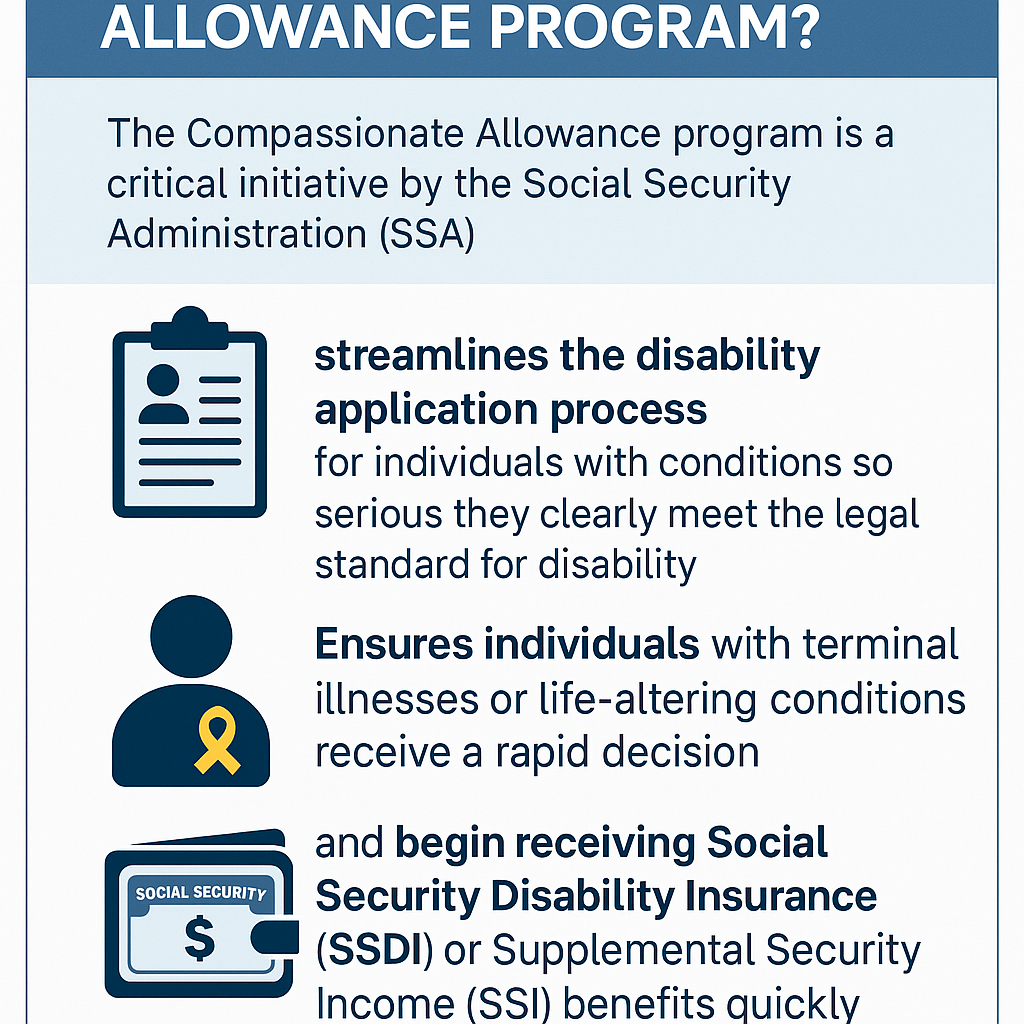
The Compassionate Allowance program, also known as the CAL program, is a dedicated initiative by the Social Security Administration (SSA) that streamlines and expedites the disability application process for individuals with severe medical conditions. The Compassionate Allowances CAL initiative is designed to quickly identify conditions that meet Social Security’s standards for disability benefits, emphasizing the speed and efficiency of the process. It ensures individuals with terminal illnesses or life-altering conditions receive a rapid decision and begin receiving Social Security Disability Insurance (SSDI) or Supplemental Security Income (SSI) quickly, providing much-needed speed in processing claims for eligible applicants.
Who Qualifies for Compassionate Allowance?
You may qualify for a Compassionate Allowance if you have a medical condition listed on the SSA’s Compassionate Allowance list, or one that is medically equivalent. The program is specifically designed to help those who are seriously sick or have life-threatening conditions. The applicant’s condition is a key factor in determining eligibility for expedited processing, as the SSA prioritizes claims for individuals with severe or terminal illnesses. You must meet SSA’s non-medical criteria and provide medical records that clearly document the diagnosis. The Social Security Administration flags eligible cases automatically—no separate application is needed.
The SSA regularly reviews potential CAL conditions to ensure that individuals with severe or rare diseases are considered for fast-tracking.
If you are applying for benefits through the Compassionate Allowance program and have a qualifying condition, you should submit your application for Social Security Disability Insurance or Supplemental Security Income as usual, and the SSA will identify and expedite your claim if your illness meets the criteria.
The Compassionate Allowances List: Covered Conditions
The SSA maintains an evolving list of over 280 Compassionate Allowance conditions, including terminal cancers (e.g., pancreatic, liver), neurological diseases (e.g., ALS, early-onset Alzheimer’s), rare childhood disorders (e.g., Batten disease), and other catastrophic conditions like inoperable brain tumors or malignant MS.
How to Apply for Fast-Tracked SSDI Through Compassionate Allowance

- Gather your medical record.
- Apply online at www.ssa.gov, by phone at 1-800-772-1213, or in person. When applying, consider calling the SSA or a legal representative for assistance with your application.
- Flag your condition for CAL if possible.
- Consider legal representation to avoid delays. Approvals often occur within 2 to 6 weeks for well-documented CAL conditions. If your claim is delayed or denied, your case may go before an administrative law judge, which can result in significant wait times.
Understanding the SSA’s Review and Approval Process
Social Security software flags CAL-eligible diagnoses, then a Disability Determination Services (DDS) examiner reviews the case. If the diagnosis matches a CAL condition and records support it, the claim is approved without extensive review. SSDI benefits begin five months after onset; SSI benefits start immediately if eligible.
Benefits of the Compassionate Allowance Program
The Compassionate Allowance Program (CAP) offers significant advantages for individuals facing severe disabilities and life-altering medical conditions. One of the most important benefits is the rapid access to disability benefits, with many applicants receiving a decision in just weeks rather than enduring months of uncertainty. This faster process is especially crucial for those diagnosed with conditions like brain cancer, certain cancers, rare disorders, and other cal conditions, where immediate financial support can make a critical difference.
By streamlining the review process, the compassionate allowance program ensures that applicants with qualifying medical conditions are automatically approved for benefits, provided they meet other eligibility requirements. This means less waiting, less stress, and a quicker path to the support needed to survive and manage daily living expenses. For individuals and families coping with severe diseases and disabilities, the ability to receive benefits quickly allows them to focus on their health and care, rather than worrying about how to pay for basic needs.
The CAP also reduces the administrative burden on both applicants and the Social Security Administration, making the process more efficient for everyone involved. By prioritizing the most serious conditions, the program helps ensure that those who need help the most can access disability benefits without unnecessary delays. Ultimately, the compassionate allowance program improves the quality of life for individuals with certain medical conditions by providing timely access to essential resources and support.
Common Conditions That Receive Quick SSDI Approval
Examples include ALS, stage IV or inoperable cancers, acute leukemia, glioblastoma, organ transplant recipients, Huntington’s disease, and severe pediatric disorders. These diagnoses are prioritized for fast-track SSDI approval due to their severity.
FAQs About Compassionate Allowances and Expedited Disability Benefits
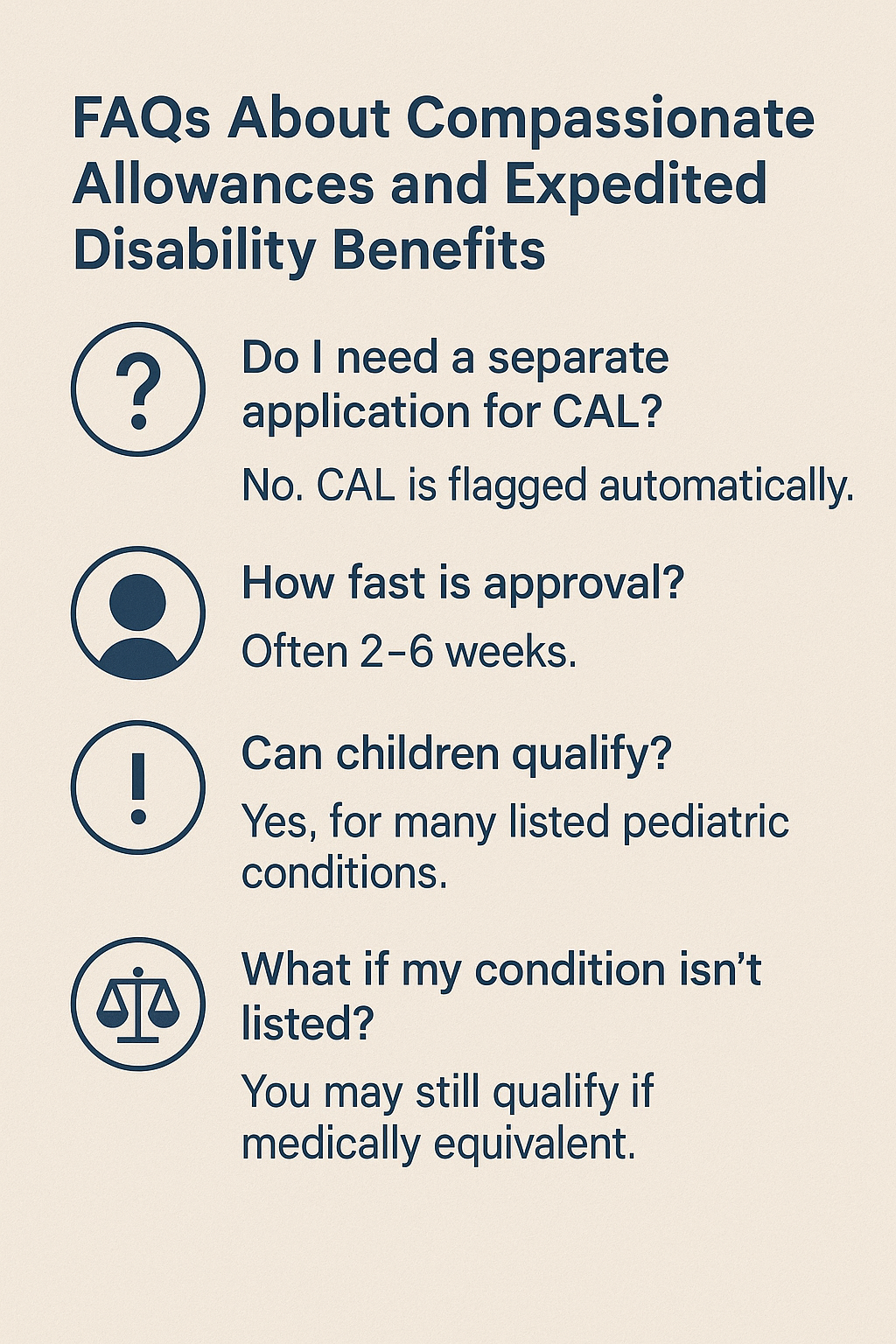
Q: Do I need a separate application for CAL?
A: No. CAL is flagged automatically.
Q: How fast is approval?
A: Often 2–6 weeks.
Q: Can children qualify?
A: Yes, for many listed pediatric conditions.
Q: What if my condition isn’t listed?
A: You may still qualify if medically equivalent.
Q: Do I need a lawyer?
A: Not required, but helpful to prevent errors or delays.
New Conditions
- Adult Heart Transplant Wait List (Levels 1–4)
- Child Heart Transplant Wait List (1A/1B)
- PACS1 Syndrome
- Plasmablastic Lymphoma
- Renal Medullary Carcinoma
- Snijders Blok–Campeau Syndrome
Technological Framework
The CAL process leverages a database of predefined medical conditions. Here’s how it works:
Condition Matching: When an application is submitted, the system cross-references the applicant’s reported medical conditions with the CAL database. The database includes conditions that automatically qualify for disability benefits due to their severity.
Automated Identification: If a match is found, the system flags the application for expedited processing. The cases CAL handles require minimal additional review because the conditions are pre-approved for fast-tracking.
Updates and Refinement: The SSA regularly updates the CAL database to include emerging medical conditions and diseases, ensuring that the process remains relevant.
Machine Learning and CAL
While CAL relies heavily on predefined conditions, advancements in machine learning may enable future iterations to identify patterns across less common conditions. For example, a machine learning algorithm could analyze medical records to suggest new conditions for inclusion in the CAL database to further improve the program’s reach and effectiveness.
Impacts and Outcomes
Reduction and Processing Times
Both QDD and CAL have drastically reduced wait times, leading to quick disability determination decisions. Cases that previously took months are now resolved in a matter of days, providing timely assistance to those in need.
Accuracy and Efficiency
Both programs maintain high levels of accuracy while streamlining evaluations. The use of technology ensures that only eligible applicants benefit from expedited processing, maintaining the integrity of the system.
Statistics and Data
Since their inception, QDD and CAL have processed hundreds of thousands of cases. These efforts have provided critical support to individuals who might otherwise face prolonged uncertainty.
- QDD Success Rates: A significant percentage of QDD-flagged cases are approved within weeks, with minimal error rates.
- CAL Coverage: As of this writing, the CAL initiative has expanded to cover over 250 medical conditions and has benefited tens of thousands of applicants annually.
Challenges and Considerations
Ensuring Equity and Fairness – ensuring that underrepresented populations are not disadvantaged by predictive modeling is a key focus area. It analyzes outcomes across demographic groups to maintain equitable treatment for all applicants.
Continuous Improvement – Ongoing adjustments to the programs account for changes in applicant demographics and advancements in medical knowledge.
Transparency in Technology – As technology becomes more integral to disability determinations, transparency is critical. The SSA has made efforts to explain how QDD and CAL function so that the public can trust these systems are equitable.
Future Directions
Improve Predictive Accuracy – analyze more data points, including unstructured medical records and physician notes, to refine probability scores
Enhanced Fraud Detection – Advanced algorithms could identify inconsistences in applications, reducing the likelihood of fraudulent claims
Personalize Evaluations – further customizing evaluations to individual medical histories, the SSA could provide more nuanced assessments
Efforts are underway to broaden the list of conditions covered by CAL and to refine the predictive capabilities of QDD. The initiatives will make expedited processes accessible to more applicants
The SSA’s use of technology for quick disability determination decisions shows how tech can make life easier for people in need. Predictive models and automation, like those used in QDD and CAL, cut down on wait times and make decisions fairer and more consistent. SSA’s tech is built to handle large volumes of data efficiently and integrate seamlessly with existing SSA workflows, which helps to minimize disruptions and maximize productivity. The scalable nature of the technology also ensures the SSA can adapt to rising application numbers without sacrificing performance or accuracy.
Benefits.com Can Help You!
In conclusion, the Compassionate Allowance Program is a vital initiative from the Social Security Administration that provides expedited access to disability benefits for individuals with severe medical conditions. By fast-tracking claims and automatically approving applicants with certain cal conditions, the program ensures that those facing the most serious disabilities and diseases receive the support they need without lengthy delays.
To qualify for the compassionate allowance program, applicants must meet specific eligibility requirements, including having a medical condition that matches or is equivalent to those listed by the SSA. Understanding the application process and reviewing the SSA’s Compassionate Allowance Listing—covering a wide range of conditions such as certain cancers and rare disorders—are essential steps for anyone seeking benefits. Individuals can visit the SSA’s website, contact their local office, or reach out to organizations like Parmele Disability Advocates for guidance and support throughout the process.
Check us out at Benefits.com and take our quiz so we can get started helping you on your path to receiving benefits.
 Benefits.com Advisors
With expertise spanning local, state, and federal benefit programs, our team is dedicated to guiding individuals towards the perfect program tailored to their unique circumstances.
Rise to the top with Peak Benefits!
Join our Peak Benefits Newsletter for the latest news, resources, and offers on all things government benefits.