














Working part time does not automatically disqualify you from disability benefits, but it can affect your eligibility depending on the type of benefits you receive and how much you earn. The Social Security Administration (SSA) uses a five-step process to determine disability eligibility, which includes evaluating your work history, medical condition, and monthly income.
For SSDI, the key question is whether your work rises to the level of substantial gainful activity (SGA).
Why This Update Matters (January 2026)
Disability rules don’t change overnight, but income limits and SSA enforcement priorities do shift over time. This January 2026 update reflects how part-time work is currently evaluated by Social Security and why careful planning still matters. Real people rely on this information to make real decisions about rent, healthcare, and survival — and outdated advice can cost someone their benefits.
Author’s Take
As someone who works with disability cases regularly, I see this mistake all the time: people assume “part time” automatically means “safe.” Unfortunately, SSA doesn’t think in terms of hours — it thinks in terms of earnings, consistency, and functional ability. If the SSA determines that your ability to work is not significantly limited, or if you are working full-time, your disability claim can be denied. A little planning can make the difference between working safely and triggering a denial or termination.
Can You Work Part Time While Receiving Disability Benefits?
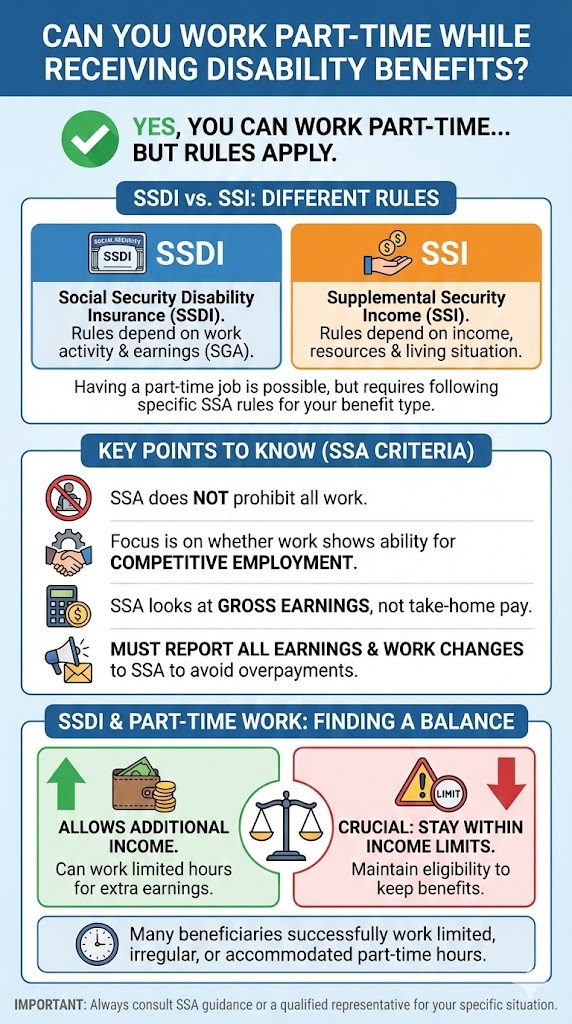
Yes — you can work while on disability, but the rules depend on whether you receive SSDI or SSI. Having a part time job can allow you to receive disability benefits, as long as you follow SSA rules regarding income and work activity.
Key points to know:
- Social Security does not prohibit all work
- The issue is whether your work shows you can engage in competitive employment
- SSA looks at gross earnings, not take-home pay
- You must report all earnings and changes in work activity to the SSA to avoid overpayments
Receiving SSDI benefits allows for some additional income from a part time job, but it is crucial to stay within SSA’s income limits to maintain eligibility. Many beneficiaries successfully work limited hours, especially when the work is irregular, low-paying, or accommodated.
How Part-Time Income Affects SSDI vs. SSI
Working Part Time on SSDI
For SSDI, the main concern is substantial gainful activity (SGA).
- To qualify for SSDI, you must earn work credits through employment or self-employment; self-employed individuals have special rules for calculating earnings and reporting income.
- Work credits are required for SSDI eligibility and can be earned through up to four credits per year based on your income.
- If your gross monthly earnings stay below the SSDI earnings limit (a certain amount set by SSA), you generally remain eligible.
- SSA may still examine whether your work shows an ability to sustain full-time employment.
- Work activity can trigger a continuing disability review (CDR).
Part-Time Work and SSI Benefits
SSI uses earned income rules, not SGA alone.
- The SSI program is designed for individuals with limited income and resources, and monthly benefits are reduced by $1 for every $2 earned after the first $65 of earned income and the first $20 of any income.
- The SSA typically ignores the first $20 of any income and the first $65 of earned income when calculating SSI benefits.
- The SSA considers job-related expenses and work-related deductions, such as Impairment-Related Work Expenses (IRWE), when evaluating your earnings, which can help offset income and potentially increase your SSI payment.
- Every dollar earned can reduce your SSI payment after these exclusions and deductions.
- Even low earnings must be reported, including self-employment income, which is also subject to SSA’s income limits and reporting requirements.
In short: SSI is more sensitive to part-time work than SSDI.
Earnings Limits, Trial Work Periods, and Key Rules to Know
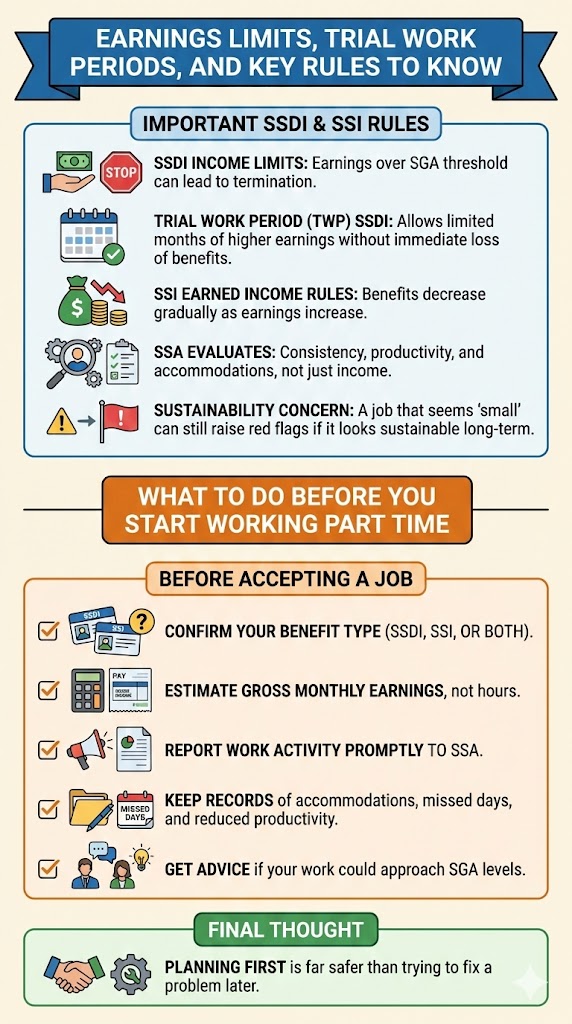
Important SSDI and SSI rules include:
- SSDI income limits: Earnings over the SGA threshold can lead to termination
- Trial Work Period (TWP) SSDI: Allows limited months of higher earnings without immediate loss of benefits
- SSI earned income rules: Benefits decrease gradually as earnings increase
- SSA evaluates consistency, productivity, and accommodations, not just income
A job that seems “small” can still raise red flags if it looks sustainable long-term.
What to Do Before You Start Working Part Time
Before accepting a job:
- Confirm your benefit type (SSDI, SSI, or both)
- Estimate gross monthly earnings, not hours
- Report work activity promptly to SSA
- Keep records of accommodations, missed days, and reduced productivity
- Get advice if your work could approach SGA levels
Planning first is far safer than trying to fix a problem later.
Example Scenario: Working While Receiving SSI
Angela receives Supplemental Security Income (SSI) due to severe anxiety and chronic pain. She lives alone and relies on SSI to cover basic expenses. Wanting to stay engaged without risking her benefits, Angela accepts a part-time cleaning job at a small office.
- She works 8–10 hours per week
- She earns about $500 per month gross
- Her hours fluctuate depending on her symptoms
- She reports her earnings to SSA every month
Because SSI uses earned income rules, Angela’s SSI payment is reduced, but not eliminated. SSA excludes a portion of her earnings and counts the rest when calculating her monthly payment. As long as her income and resources stay below SSI limits, she remains eligible for SSI, even though her check is smaller.
Why This Work Is Generally Considered “Safer” for SSI
- Earnings are low and inconsistent
- Work does not resemble full-time employment
- Income is reported timely
- Her symptoms continue to limit reliability and productivity
What Could Make This Risky
If Angela’s earnings increase or become consistent month after month, SSA could:
- Reduce her SSI payment further
- Temporarily suspend payments
- Terminate SSI if income or resources exceed limits
- Assess an overpayment if earnings are not reported
Example Scenario: Working While Receiving SSDI
James receives Social Security Disability Insurance (SSDI) due to degenerative disc disease and chronic radiculopathy that limit his ability to sit, stand, and maintain consistent attendance. After being on SSDI for two years, James decides to try part-time work to see if he can tolerate some activity.
James accepts a flexible, part-time desk position with a small nonprofit.
- He works 10–12 hours per week
- He earns about $900 per month gross
- His schedule varies based on pain flares
- He requires frequent position changes and unscheduled breaks
- He reports his work activity and earnings to SSA
James’ earnings remain below the SSDI earnings limit, and his employer accommodates his limitations. Because his work is inconsistent, requires accommodations, and does not show the ability to sustain full-time competitive employment, his SSDI benefits continue.
Why SSA Did Not Find This Disqualifying
- Earnings stayed below substantial gainful activity (SGA)
- Work activity was limited and inconsistent
- Productivity was below competitive standards
- Accommodations were required to maintain even part-time work
- Medical evidence continued to support ongoing limitations
SSDI allows limited work — but SSA watches for signs you can sustain competitive employment. The closer work looks to a regular job, the higher the risk to benefits.
Frequently Asked Questions
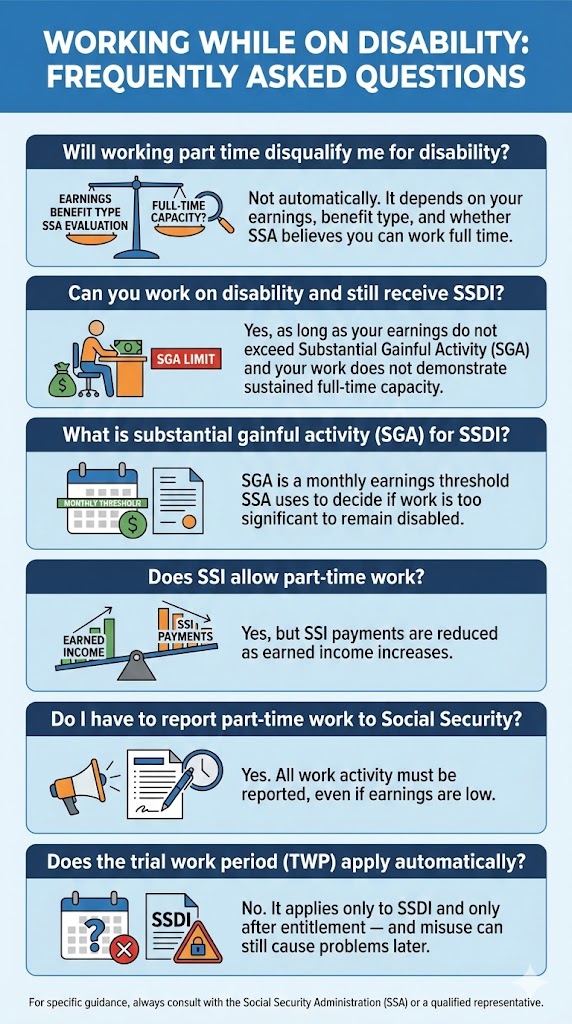
Will working part time disqualify me for disability?
Not automatically. It depends on your earnings, benefit type, and whether SSA believes you can work full time.
Can you work on disability and still receive SSDI?
Yes, as long as your earnings do not exceed SGA and your work does not demonstrate sustained full-time capacity.
What is substantial gainful activity for SSDI?
SGA is a monthly earnings threshold SSA uses to decide if work is too significant to remain disabled.
Does SSI allow part-time work?
Yes, but SSI payments are reduced as earned income increases.
Do I have to report part-time work to Social Security?
Yes. All work activity must be reported, even if earnings are low.
Does the trial work period apply automatically?
No. It applies only to SSDI and only after entitlement — and misuse can still cause problems later.
If you have more questions about your eligibility for benefits, or how your work schedule is impacting them, please reach out to us here at Benefits.com! We are here to help sort out all the confusion surrounding these benefits.
 Benefits.com Advisors
With expertise spanning local, state, and federal benefit programs, our team is dedicated to guiding individuals towards the perfect program tailored to their unique circumstances.
Rise to the top with Peak Benefits!
Join our Peak Benefits Newsletter for the latest news, resources, and offers on all things government benefits.